
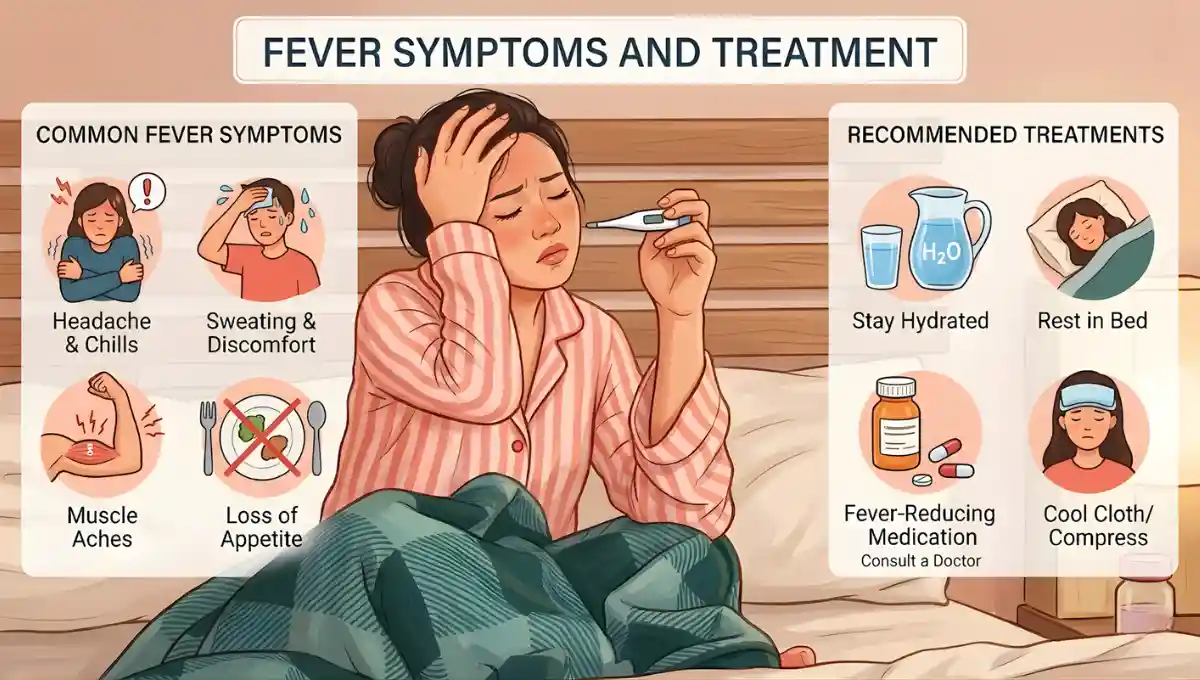
A fever is a body temperature usually above 38°C (100.4°F) and is your body’s way of fighting infections like colds, flu, COVID‑19, dengue, or typhoid. Most fevers in healthy adults are mild, self‑limited, and safely managed at home with rest, fluids, and simple medicines like paracetamol. However, some fever symptoms and treatment situations are dangerous and need urgent medical help, especially when fever comes with confusion, stiff neck, severe headache, rash that does not fade, or trouble breathing.
This article will help you:
- Understand what a fever really means
- Recognize warning signs vs mild symptoms
- Make clear, fast decisions (home care vs doctor vs emergency)
- Avoid common mistakes many people make with fever
- Understand what happens if you ignore fever too long
What Is a Fever? (The Simple Science)
A fever is not a disease itself; it is a symptom that your body uses to defend against infection. When viruses or bacteria enter your system, immune cells release substances called pyrogens, which tell the brain to raise your “set point” temperature. This higher body temperature makes it harder for many pathogens to multiply and helps your immune cells work more efficiently.
In medical terms, fever is defined as a body temperature of 38°C (100.4°F) or higher when measured by mouth or under the rectum. In adults, temperatures between 38–39°C are usually called mild fever, while above 39.5–40°C enters the high‑risk range where medical attention is important. Children and elderly people may show different patterns, so fever symptoms and treatment must be interpreted in context.
Key points to remember:
- Fever is a body‑defence response, not always “danger.”
- Mild fever often means common infection, not an emergency.
- Very high fever (≥40°C), long‑lasting fever, or fever with red‑flag symptoms must be taken seriously.
What Should You Do RIGHT NOW?
Before diving deep into causes and details, let’s give you an immediate, no‑fluff decision script for fever symptoms and treatment. This is what you can follow in most real‑life situations.
Fever Decision Shortcuts for Adults and Children
Use this simple table to decide what to do right now when fever hits:
| Situation | What You Should Do Immediately |
|---|---|
| Fever < 38.5°C, no red flags | Rest, fluids, light clothing. No routine medicine needed. Monitor for 24–48 hours. |
| Fever 38.5–39.5°C (mild to high) | Take paracetamol or ibuprofen if uncomfortable; rest, fluids, cool cloth. |
| Fever > 39.5°C (high) | Contact a doctor; do not delay if above 40°C (104°F). |
| Fever + confusion / stiff neck / rash that doesn’t fade | Go to ER immediately – possible meningitis or sepsis. |
| Baby < 3 months with any fever ≥ 38°C | Go to emergency immediately – this is an emergency, not “wait and see.” |
| Child 3–24 months with fever ≥ 39°C for more than 24 hours | See a doctor today. |
| Anyone with fever and trouble breathing | Seek urgent medical care. |
The idea is simple: treat fever discomfort, monitor symptoms, and act fast when danger signs appear. You don’t need to panic over every number on the thermometer, but you should never ignore red‑flag symptoms.
Common Symptoms of Fever
Mild Fever Symptoms (Usually Safe at Home)
Most fevers start with a mixture of warmth, tiredness, and body discomfort. Common mild symptoms include:
- Feeling hot, flushed, or sweaty
- Mild body aches or stiffness
- Slight headache
- Mild loss of appetite or nausea
- Feeling tired or drowsy
- Occasional chills or shivering as the fever rises
These symptoms often accompany a viral cold, flu, or mild infection and usually improve within 3–5 days with rest and fluids. In most healthy adults, fever symptoms and treatment at this stage can be managed at home.
Important:
- Mild fever with no red‑flag symptoms is usually not an emergency.
- Focus on rest, hydration, and monitoring rather than aggressive medicine.
Serious Fever Symptoms (Red Flags)
Certain symptoms with fever are warning signs that the infection may be more serious. If you see any of these, seek medical help fast:
- Fever above 40°C (104°F)
- Confusion, delirium, or unusual behavior
- Severe headache + stiff neck
- Rash that does not fade when pressed (put a clear glass over it and press)
- Trouble breathing, chest pain, or rapid breathing
- Seizure or convulsions
- Repeated vomiting or inability to drink fluids
- Dark or very reduced urine output (sign of dehydration)
These fever symptoms and treatment patterns can suggest serious infections like meningitis, sepsis, severe viral illness, or dengue with complications. In such cases, do not wait for the fever to “come down on its own” – seek urgent care.
Causes of Fever
Common Infections That Cause Fever
Most fevers are caused by infections, which can be viral or bacterial. Some of the most common causes include:
- Viral infections: Cold, flu, COVID‑19, dengue, hepatitis, measles, chickenpox
- Bacterial infections: Strep throat, urinary tract infection (UTI), pneumonia, typhoid, tuberculosis, meningitis
- Post‑vaccination fever: Common after many vaccines, usually mild and short‑lived
- Inflammatory or autoimmune diseases: Lupus, rheumatoid arthritis, some types of vasculitis
Fever symptoms and treatment are closely linked here because the treatment focus is on both relieving symptoms and treating the underlying cause. Mild viral fevers usually just need supportive care, whereas bacterial infections often require antibiotics under medical supervision.
Hard‑truth insight:
While fever symptoms and treatment are often discussed together, treating only the fever with medicine does not cure the infection. Antibiotics or antivirals (if needed) must always be guided by a doctor.
Non‑Infectious Causes of Fever
Fever can also occur without infection, for example:
- Heat exhaustion or heat stroke
- Drug reactions or side effects
- Autoimmune diseases (like lupus or rheumatoid arthritis)
- Certain cancers (especially lymphomas or leukemia)
- Post‑surgical or post‑injury inflammatory response
These causes are less common but important. If fever keeps returning without clear infection, or lasts more than 3 weeks, it is called “fever of unknown origin” and needs detailed medical evaluation.
Types of Fever (When Pattern Matters)
Continuous, Remittent, and Intermittent Fever
Doctors classify fever by its pattern over time, which can help guess the cause:
- Continuous fever: Temperature stays high day and night, rarely returning to normal (common in typhoid or pneumonia).
- Remittent fever: Temperature fluctuates but never fully returns to normal (seen in some serious infections).
- Intermittent fever: Fever spikes then falls back to normal (classical in malaria).
- Pel‑Ebstein pattern: Fever recurs in cycles with fever‑free periods (seen in some lymphomas).
- Fever of unknown origin (FUO): Fever lasting more than 3 weeks with no clear cause after standard tests.
Not every patient needs to know these terms, but if your fever returns in a regular pattern for more than a week, that pattern itself is a clue your doctor should check.
Diagnosis: How a Doctor Checks If It’s “Just a Fever”
Basic Clinical Examination
When you visit a doctor with fever symptoms and treatment concerns, the process usually starts with:
- Taking an accurate temperature (oral, rectal, or tympanic).
- Checking general condition: hydration, breathing, mental status, rash, neck stiffness.
- Asking key questions: how long fever has lasted, how high it went, other symptoms, travel history, vaccination status.
This history and exam helps decide whether the fever is likely mild and self‑limited or serious requiring urgent tests or hospital care.
When Lab Tests or Imaging Are Needed
Testing is usually advised if:
- Fever for more than 3 days without improvement.
- Very high fever (≥40°C) or repeated spikes.
- Red‑flag symptoms (confusion, stiff neck, rash, breathing trouble).
- Recent travel to areas with malaria, dengue, or typhoid.
- High‑risk groups (babies, elderly, pregnant, immunocompromised).
Common tests:
- Complete blood count (CBC) to check for infection or inflammation
- Blood culture to detect bacteria in the blood
- Urine test for urinary infection
- Chest X‑ray for pneumonia or chest infection
- Dengue, malaria, typhoid, or other specific tests if risk is present
Takeaway:
Diagnosis is not just about fever symptoms and treatment, but identifying what is causing the fever so the right treatment can be given.
Treatment Overview (Simple, Evidence‑Based)
At‑Home Care for Most Fevers
For mild to moderate fever symptoms and treatment in adults and older children, the core principles are:
- Rest: Your immune system works best when you are not rushing or overexerting.
- Hydration: Drink water, coconut water, buttermilk, or oral rehydration solution. Aim for pale‑yellow urine and frequent urination.
- Cool compress: Use a lukewarm damp cloth on the forehead or neck; avoid ice baths or very cold water, which can cause shivering and raise internal temperature.
- Light clothing: Wear cotton clothes and use a light sheet instead of heavy blankets.
- Comfortable room temperature: Keep the room cool but not cold.
These steps help your body fight the infection while staying comfortable.
When and How to Use Medicines
Medicines are not always needed for every fever, but they are useful when:
- Fever causes significant discomfort or pain.
- Temperature is high (≥38.5–39°C) or the person feels unwell.
- The person has underlying health issues or is in a high‑risk group.
Common medicines:
- Paracetamol (acetaminophen): First‑line for most adults and children; effective for fever and pain.
- Ibuprofen: Good for higher fever and body ache; avoid in children under 6 months or with kidney problems.
- Avoid aspirin in children and teens – linked to Reye’s syndrome (a rare but dangerous condition).
Important:
- Do not exceed recommended doses (usually 3–4 g/day of paracetamol in adults, spaced 4–6 hours apart).
- Avoid combining multiple paracetamol‑containing cold medicines, which can lead to overdose.
- Use medicines to relieve discomfort, not to force the temperature down to a perfect “normal.”
Prevention Tips (What Really Works)
Everyday Habits to Reduce Fever Risk
While you cannot prevent all fevers, you can greatly reduce the risk of serious fever symptoms and treatment episodes by:
- Handwashing: Regularly with soap and water, especially before meals and after using the toilet or public places.
- Vaccinations: Keep up‑to‑date with flu, typhoid, COVID‑19, and age‑appropriate vaccines.
- Avoid close contact with people who are clearly sick (coughing, fever, flu‑like symptoms).
- Stay hydrated and sleep well – a tired, dehydrated body fights infections poorly.
- Treat infections early – don’t ignore persistent sore throat, cough, or urinary symptoms that can lead to higher‑grade fevers.
These habits help your body stay ready to handle infections without turning every cold into a high‑risk situation.
Biggest Mistakes People Make with Fever
Overusing Antibiotics and Paracetamol
Many people repeat the same errors when dealing with fever symptoms and treatment:
- Demanding antibiotics for viral fever: Antibiotics do not work on viruses and contribute to antibiotic resistance.
- Overusing paracetamol or ibuprofen every few hours “just in case,” which can lead to liver or kidney damage if doses are too high or too frequent.
- Ignoring dehydration – dark urine, dry mouth, dizziness, or no urine for 8–12 hours are serious signs.
- Bundling up heavily – thick blankets trap heat and push the temperature higher instead of helping it come down.
- Waiting too long for “simple” fever in babies or elderly – even a mild‑looking fever can hide serious infection in these groups.
Hard‑truth insight:
Most fevers are harmless, but ignoring warning signs or using medicines incorrectly can delay diagnosis and cause complications like sepsis, kidney damage, or liver problems.
Confusing “Normal” vs “Dangerous” Fever
Another common mistake is thinking that any fever is dangerous or, on the opposite side, that a “small” number is always safe. Reality lies in the middle:
- A mild fever (38–38.9°C) in a healthy adult with no red‑flag symptoms is usually not dangerous.
- A low‑grade fever (38.1°C) in a baby under 3 months or an elderly person with confusion can be very serious.
Decision rule:
- Focus on the person, not just the number.
- If the person feels very unwell, confused, or has red‑flag symptoms, treat it as urgent regardless of the exact temperature.
What Happens If You Ignore Fever? (Real Consequences)
Sepsis and Organ Damage Risk
Ignoring fever symptoms and treatment warning signs can lead to severe complications:
- Sepsis: The body’s extreme response to infection can cause very high fever, confusion, low blood pressure, and organ failure. Sepsis can be life‑threatening if not treated early.
- Meningitis: Infection of the brain’s protective coverings often presents with high fever, stiff neck, severe headache, and light sensitivity. If untreated, it can cause brain damage or death.
- Brain damage from extreme fever (hyperpyrexia): Temperatures above 41.1°C (106°F) can damage brain cells and other organs, though this is rare.
- Delayed diagnosis of dengue, typhoid, or malaria: Waiting too long can miss the window for optimal treatment and increase the risk of complications.
Hard‑truth insight:
Ignoring fever when danger signs are present can turn a treatable illness into a medical emergency. It is far safer to get checked early than to wait and hope it will go away.
When to See a Doctor
When to See a Doctor Soon
See a doctor today or within 24–48 hours if:
- Fever has lasted more than 3 days without improvement.
- Temperature is above 39.5–40°C.
- Fever comes back repeatedly over several days.
- You have recent travel history to malaria‑ or dengue‑risk areas.
- You are pregnant and have a fever above 38°C.
- You are elderly, immunocompromised, or have chronic illness and feel unwell.
Do not wait for the fever to reach some “magic” high number if you feel very sick or something feels wrong.
Emergency Signs – Go to ER Immediately
Go to the emergency room right away if you have fever plus any of these:
- Confusion, delirium, or strange behavior
- Stiff neck, severe headache, or light sensitivity
- Skin rash that does not fade when pressed
- Trouble breathing, chest pain, or rapid breathing
- Seizure or loss of consciousness
- Baby under 3 months with any fever ≥ 38°C
- Repeated vomiting or inability to drink fluids
Remember:
- For babies and elderly, the threshold for “see a doctor” is much lower.
- If in doubt, it is safer to get checked early than to wait.
High‑Risk Groups: Extra Caution Needed
When Fever Is More Dangerous
Certain groups need extra caution with fever symptoms and treatment because their bodies respond differently to infection and fever. For them, even a mild‑looking fever can be a sign of serious illness. These high‑risk groups include:
- Babies under 3 months: Any fever ≥38°C is an emergency.
- Children under 2 years who have high fever (≥39°C) or fever that lasts more than a day or two.
- Elderly people (65+) who may show confusion, weakness, or low energy instead of very high temperature.
- Pregnant women because high fever can affect the developing baby, especially in early pregnancy.
- People with weak immunity: Those on chemotherapy, HIV‑positive, organ‑transplant recipients, or on long‑term steroid medicines.
- People with diabetes, kidney disease, heart disease, or lung disease, where infection can quickly become serious.
For these groups, “when in doubt, get checked early” is the safest rule. It is better to have a doctor check a “mild” fever in a high‑risk person than to assume it will go away on its own.
Real‑Life Fever Scenarios (Decision‑Focused)
Scenario 1 – Mild Adult Fever
You are 30 years old, with a temperature of 38.3°C, body ache, mild headache, and runny nose for 1 day.
- Likely cause: Viral cold or flu.
- Fever symptoms and treatment at home:
- Rest, light fluids, and paracetamol only if uncomfortable.
- Do not force heavy medicines or antibiotics.
- If fever lasts more than 3 days or symptoms get worse, see a doctor.
Decision takeaway: This is usually not an emergency but should be monitored closely.
Scenario 2 – Child with Persistent Fever
Your 5‑year‑old child has a fever of 38.8°C that has lasted 4 days. The child is eating less, cranky, but not dehydrated or confused.
- Likely cause: Viral infection that is taking longer than usual or a mild secondary bacterial infection.
- What to do:
- Keep giving fluids and paracetamol as needed.
- See a doctor the same day; fever lasting more than 3–5 days in children should be evaluated.
This is a classic example where fever symptoms and treatment require timely medical review, not just home observation.
Scenario 3 – Adult with Alarming Signs
A 35‑year‑old has 39.8°C fever, severe headache, stiff neck, and aversion to bright light. The person feels very unwell and is confused.
- Possible cause: Meningitis or another serious brain or spinal infection.
- Urgent action: Go to the emergency room immediately.
- Do not wait for medicines to “bring fever down” or assume it’s just a bad cold.
This is a situation where ignoring fever and its warning signs can lead to life‑threatening complications.
Scenario 4 – Elderly or High‑Risk Adult
A 72‑year‑old has 38.1°C fever, mild cough, and new confusion or drowsiness. The person did not have high fever before and feels “off.”
- Possible cause: Early pneumonia, urinary infection, or other bacterial infection in an elderly person.
- Action:
- Contact a doctor urgently or visit a clinic/emergency.
- Elderly patients often show lower fever but more mental‑change symptoms like confusion or dizziness.
For this group, even a low‑grade fever with confusion should be treated as serious.
What to Avoid: Critical Safety Mistakes
Dangerous Home Practices
Many people unintentionally make fever worse with simple mistakes. Avoid these at all costs:
- Using cold water baths or ice packs on the whole body: This can cause shivering, which produces more internal heat and may raise the core temperature.
- Over‑bundling a child or baby in multiple blankets: Extra heat worsens fever and can increase the risk of dehydration.
- Giving aspirin to children or teenagers for fever or flu‑like illness: Aspirin is linked to Reye’s syndrome, a rare but life‑threatening condition affecting the liver and brain.
- Mixing different paracetamol‑containing medicines (cold syrups, painkillers, combination tablets): This can cause accidental overdose, leading to liver damage.
- Ignoring dehydration signs: Dry mouth, very dark urine, dizziness, or not urinating for many hours is a red flag.
Important:
If you or your child is vomiting repeatedly or cannot drink fluids, seek medical help immediately – dehydration with fever is dangerous.
Psychological Mistakes (From Anxiety to Delay)
Along with physical mistakes, people often make emotional or mental mistakes when dealing with fever symptoms and treatment:
- Panicking over every small temperature rise and rushing to the ER for mild fever.
- Ignoring serious symptoms because of fear of hospitals or costs and hoping it will go away.
- Self‑diagnosing severe infections using Google alone instead of seeing a doctor.
Practical advice:
- Stay calm, but be alert.
- Use the “decision shortcuts” listed earlier to decide if it’s home care, doctor, or ER.
- If you feel something is “wrong,” trust your gut and get checked.
What Happens If You Ignore Fever? (Advanced Consequences)
Progression from Mild Infection to Critical Illness
Ignoring fever with warning signs can allow a simple infection to progress into something far more serious:
- Untreated UTI can move to kidney infection (pyelonephritis) or sepsis.
- Mild pneumonia can worsen into severe pneumonia with low oxygen levels if fever, cough, and shortness of breath are ignored.
- Dengue or malaria can progress to shock, bleeding, or organ failure if early warning signs like persistent high fever, abdominal pain, or bleeding are dismissed.
Hard‑truth takeaway:
Early fever is often the first sign that something needs medical attention. Delaying care can turn a manageable illness into a life‑threatening condition.
Long‑Term Risks of Repeated Febrile Illness
Frequent or repeated fevers due to repeated infections can also cause long‑term problems, especially if not managed well:
- Repeated high‑grade fevers can strain the heart and other organs, especially in older adults or those with existing heart disease.
- Repeated use of medicines without guidance (especially antibiotics or painkillers) can cause kidney problems, liver issues, and antibiotic resistance.
- Chronic low‑grade fever without clear cause might hide autoimmune disease or cancer, so it should be investigated if it lasts more than a few weeks.
Doctor’s advice:
If you have multiple febrile episodes in a short time (for example, fever every month), ask your doctor for a full check‑up, not just fever‑only treatment.
When Fever Looks Normal But Isn’t
“Silent Fever” in Elderly and Weak Immune People
In older adults and those with weak immunity, fever symptoms and treatment can be misleading because the body does not show a high fever even with serious infection.
A person may seem “only a bit weak” or “a little confused” but the temperature is just 37.8–38.2°C, which looks mild. Yet, lab tests can reveal bacterial infection in urine, lungs, or blood.
What this means for you:
- If an elderly person suddenly becomes confused, drowsy, or weak, check temperature and see a doctor urgently, even if the fever is low.
- Do not discount mild fever in high‑risk people – it can be the only sign of serious illness.
Fever with No Clear “Source”
Sometimes a person has fever symptoms and treatment managed at home, but the fever keeps returning without clear cause. This can happen with:
- Hidden infections (like kidney infection, sinusitis, or dental infection).
- Autoimmune diseases such as lupus or rheumatoid arthritis.
- Certain cancers that cause “fever of unknown origin.”
If your fever keeps coming back even after treatment, or you have:
- Persistent low‑grade fever for more than 2–3 weeks
- Unexplained weight loss
- Night sweats
- Swollen glands or persistent pain
… then ask your doctor for further tests rather than accepting “it’s just stress” or “just a cold.”
How to Care for a Fever Patient at Home (Step‑by‑Step)
Step 1 – Confirm the Fever Correctly
- Use a digital thermometer under the tongue (oral) in adults, or rectally in small children for better accuracy.
- Record the highest temperature and time of day.
- Do not rely only on touch; sometimes a fever can be high even if the person feels cool due to sweating.
Keep noting if the fever is rising, falling, or staying the same over 24 hours.
Step 2 – Monitor Symptoms, Not Just the Number
Write down:
- How the person feels: Strong or weak, able to eat or drink.
- Other symptoms: Cough, vomiting, diarrhea, rash, neck stiffness, confusion.
- Urine output: How often and how dark it looks.
You can show this short note to your doctor, which makes fever symptoms and treatment evaluation much faster and more accurate.
Step 3 – Supportive Care at Home
Do these every 2–4 hours while the fever lasts:
- Offer fluids frequently in small amounts: water, soups, ORS, buttermilk, coconut water.
- Check body comfort: If the person is shivering, use a light blanket; if they feel too hot, use cool compresses and light clothes.
- Keep the room well‑ventilated and at a comfortable temperature.
- Encourage sleeping or resting in a calm, quiet place.
If the person is not drinking, not passing urine, or getting more confused, seek medical help without delay.
Frequently Asked Questions
What temperature is considered a fever in adults?
A fever in adults is usually defined as an oral temperature of 38°C (100.4°F) or higher. Temperatures above 39.4°C (103°F) are considered high fever and should prompt a call to your doctor.
Can a fever go away without medicine?
Yes. Most mild viral fevers get better in 3–5 days with rest and fluids, even without medicines. Paracetamol or ibuprofen help with discomfort and pain, but they don’t “cure” the infection.
Is letting a fever “run its course” dangerous?
For most healthy adults with mild fever, it is usually not dangerous, but it is important to monitor symptoms. Very high fever (≥41°C) or fever with confusion, stiff neck, rash, or trouble breathing must not be left untreated.
How do I bring a fever down quickly at home?
Take paracetamol or ibuprofen as per doctor’s or package directions.
Rest and drink plenty of fluids.
Use a cool, damp cloth on forehead or neck.
Avoid cold baths, ice, or heavy blankets.
If fever stays above 39.5°C for more than 6–8 hours, or the person feels worse, see a doctor.
When is a child’s fever an emergency?
Go to the emergency room immediately if:
Baby under 3 months has any fever ≥38°C.
Child has fever plus rash that doesn’t fade, trouble breathing, seizure, confusion, or cannot drink fluids.
Child looks very sick, pale, or extremely weak even if the number does not look very high.
For children, parental instinct plus clear red flags should guide you more than the thermometer alone.
Can fever be a sign of something serious other than infection?
Yes. Besides infections, fever symptoms and treatment can link to:
Autoimmune diseases (lupus, rheumatoid arthritis).
Certain cancers (like lymphoma or leukemia).
Medicine side effects or reactions.
Post‑surgical or post‑injury inflammation.
If fever keeps returning for weeks with no clear cause, ask your doctor to do more tests.
Disclaimer: This content is for informational purposes only and is not a substitute for professional medical advice, diagnosis, or treatment. Always consult a qualified healthcare provider for personal medical guidance.