
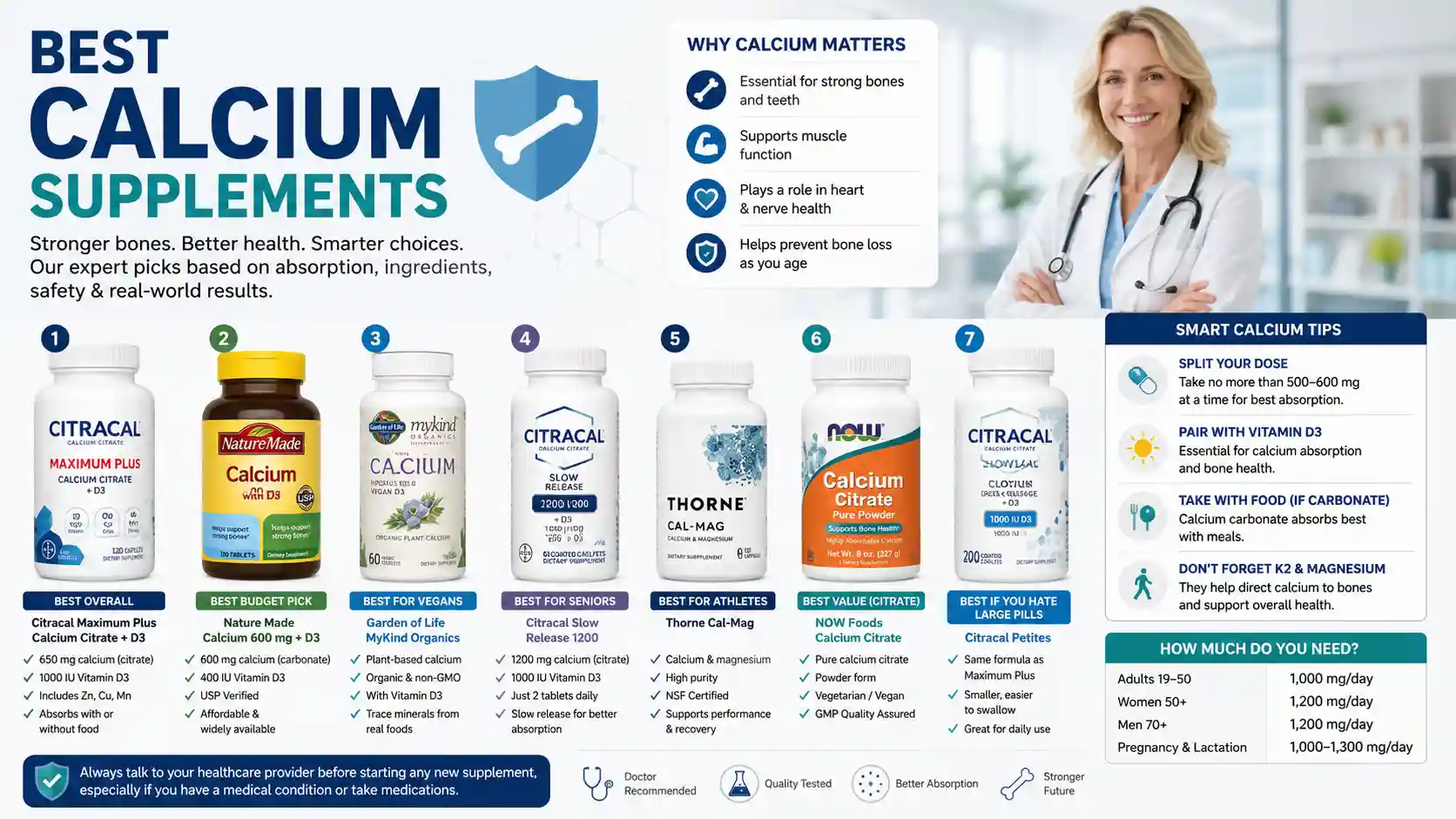
The best calcium supplement for most adults is Citracal Maximum Plus Calcium Citrate + D3. It absorbs with or without food, causes fewer digestive side effects than calcium carbonate, and includes Vitamin D3 – the nutrient your body needs to actually use the calcium you take. This guide cuts through the noise, reviews real products, exposes what most buyers get wrong, and tells you exactly what to buy based on your specific situation.
Whether you are searching for the best calcium supplement for women over 50, the safest option for seniors, or the most affordable pick for daily bone support, this decision guide gives you clear answers, not generic lists.
What Most Calcium Buyers Get Wrong
Before comparing products, understanding these mistakes saves you money and prevents zero-result supplementation.
Most people supplement calcium incorrectly – and get no measurable benefit as a result. Here is what the clinical evidence and real-world experience consistently reveal:
The Biggest Calcium Supplementation Mistakes
- Taking 1,200 mg in one dose. The gut absorbs a maximum of 500–600 mg of elemental calcium at one time. Splitting your dose is not optional – it is physiologically mandatory for the supplement to work
- Assuming “more calcium = stronger bones.” Calcium supplements alone do not reliably prevent fractures in healthy, community-dwelling adults. Diet, sunlight exposure, weight-bearing exercise, and – critically – adequate Vitamin D matter far more than raw calcium dose
- Buying calcium gummies. Most calcium gummies deliver only 200–300 mg of elemental calcium per serving, use the inferior carbonate form, and are loaded with added sugars. Poor dose, poor form, poor value – experts consistently rate them the least clinically useful calcium format
- Taking calcium carbonate without food. Carbonate requires stomach acid to dissolve. On an empty stomach, absorption can drop significantly – yet millions of users take it first thing in the morning with water and wonder why it does not work
- Ignoring Vitamin K2. Without K2, supplemental calcium can calcify in arterial walls rather than in bones. This is not a marketing claim – meta-analyses of multiple randomised controlled trials support this finding
- Thinking all citrate products are equal. Tablet, capsule, and powder formats of calcium citrate deliver measurably different bioavailability, even from the same compound
Editor’s Pick: Best Overall Calcium Supplement
Citracal Maximum Plus Calcium Citrate + D3 is the best overall calcium supplement for most adults. It uses calcium citrate, which absorbs effectively with or without food and causes fewer digestive side effects than calcium carbonate. It includes 1,000 IU of Vitamin D3 and trace bone-support minerals – zinc, copper, and manganese – making it a more complete formula than basic calcium-only products.
The pill burden is real: four large capsules daily. But on absorption reliability, formulation completeness, and clinical credibility, nothing in this price range competes with it.
Read More About – Best Vitamin D Supplements (2026)
Best Calcium Supplements by User Type
Matching the right product to your specific situation is what separates effective supplementation from wasted spending. The best calcium supplement for a postmenopausal woman differs from what an athlete or a vegan needs. Here is the clearest guide available:
| User Type | Best Pick | Why |
| Most adults | Citracal Maximum Plus | Citrate form, D3 included, no food required |
| Women over 50 | Citracal Maximum Plus + K2 (MK-7) | Cardiovascular protection, bone density |
| Budget users | Nature Made Calcium 600 mg + D3 | USP Verified, affordable, widely available |
| Vegans / dairy-free | Garden of Life MyKind Organics | Certified organic, plant-derived, trace minerals |
| Seniors/pill fatigue | Citracal Slow Release 1200 | Just 2 tablets once daily |
| Athletes / purity-focused | Thorne Cal-Mag | NSF Certified, chelated minerals, capsule format |
| Value citrate buyers | NOW Foods Calcium Citrate | Budget citrate, veg capsules, GMP certified |
Pairing any calcium supplement with one of the best Vitamin D supplements available is not optional – it is the single most impactful upgrade you can make to your calcium routine.
Top Calcium Supplements Reviewed
1. Citracal Maximum Plus – Best Overall
What you get: 650 mg elemental calcium (as citrate) + 1,000 IU Vitamin D3 + zinc, copper, and manganese per 2-caplet serving. Full daily dose = 4 caplets.
Real-world experience: The caplets are large – noticeably thicker than a standard multivitamin. But because citrate generates minimal GI friction, tolerability is excellent even without food. Users who previously experienced constipation on carbonate-based products frequently switch to Citracal and report immediate improvement. The most consistent complaint is the 4-caplet daily routine, which some users abandon after a few weeks.
Pros:
- Absorbs with or without food – maximum flexibility
- Trace bone minerals include beyond just calcium and D3
- Doctor-recommended calcium citrate brand
- No constipation or bloating in most users
Cons:
- Four large caplets per day is a genuine pill burden
- Titanium dioxide coating (some users prefer to avoid)
- Costs more than carbonate alternatives
Best for: Adults over 50, people on proton pump inhibitors or antacids, anyone without consistent meal timing.
Avoid if: You struggle with large tablets – choose Citracal Petites, the same formula in a smaller size.
Bottom Line: The most complete over-the-counter calcium formula available. If reliable absorption and formulation depth matter more than price, this is the clear choice.
2. Nature Made Calcium 600 mg + D3 – Best Budget Pick
What you get: 600 mg elemental calcium (as carbonate) + 400 IU Vitamin D3 per tablet. USP Verified – one of the most trusted third-party certifications in the supplement industry.
Real-world experience: Smooth-coated, medium-sized tablet. Largely tasteless when swallowed whole. The USP verification matters significantly here – independent testing has found that calcium supplement labels can deviate from actual content by up to 45%. Nature Made’s certification eliminates that risk. The most common real-world complaint is mild constipation after 2–3 weeks of use, which is typical for carbonate-based products and manageable with adequate water intake.
Pros:
- USP Verified – label accuracy independently confirmed
- Most affordable mainstream calcium option
- Single tablet per dose simplifies compliance
Cons:
- Must be taken with food – absorption drops without a meal
- Only 400 IU D3 – consider pairing with a separate best Vitamin D supplement if you are deficient
- Constipation risk higher than citrate alternatives
Best for: Budget-conscious adults who consistently take supplements with meals.
Avoid if: You are on acid-reducing medications – carbonate requires stomach acid to dissolve effectively.
Bottom Line: The best value calcium supplement with verified label accuracy. Take it with food, every time – that single rule determines whether it works or not.
3. Citracal Slow Release 1200 – Best for Once-Daily Convenience
What you get: 1,200 mg elemental calcium (citrate-malate blend) + 1,000 IU D3 + 80 mg magnesium in just 2 tablets, taken once daily with breakfast.
Real-world experience: Slow-release technology meaningfully reduces the GI burden of a large single calcium dose. Users who previously felt bloated on standard high-dose formulas report noticeably less discomfort here. The trade-off of taking it with breakfast is a genuine limitation for people with irregular morning schedules.
Pros:
- Two tablets, once daily – the lowest pill burden in this comparison
- Slow-release formulation reduces bloating from higher doses
- Magnesium supports bone matrix formation and sleep quality
Cons:
- Must be taken with food – no flexibility on timing
- Very large tablets
- Higher cost per serving than standard Citracal
Best for: Older adults managing multiple medications, anyone who forgets or skips multi-dose routines.
Bottom Line: For seniors or high-compliance users who want to eliminate dose-splitting entirely, this is the most practical single-product solution.
4. Garden of Life MyKind Organics Calcium – Best for Vegans
What you get: Algae-sourced calcium from Lithothamnion red algae, with naturally occurring magnesium, silica, and 72 trace minerals. USDA Organic, Certified Vegan, Non-GMO Verified.
Real-world experience: Tablets are smaller than most calcium supplements – a genuine advantage in a category dominated by oversized pills. First-time users are often surprised by a mild oceanic smell from the algae source. It is completely natural and harmless, but unexpected if you are not prepared for it. GI tolerance is the best in this list – the organic whole-food matrix processes similarly to food, which means minimal constipation or bloating.
Pros:
- 100% plant-derived – vegan and vegetarian appropriate
- Smaller tablet size – meaningfully easier to swallow
- Co-nutrients from algae (magnesium, silica, boron, 72 trace minerals)
- No synthetic fillers or additives
Cons:
- Significantly more expensive than synthetic options
- Mild algae smell on first opening
- Lower elemental calcium per serving than synthetic alternatives
Best for: Vegans, dairy-intolerant users, clean-label-conscious buyers, people who reacted poorly to synthetic calcium.
Avoid if: Cost is a priority – you pay a meaningful premium for organic sourcing.
Bottom Line: The best vegan calcium supplement available. The organic credentials and co-nutrient profile justify the price – for users who need plant-derived minerals specifically.
5. Thorne Cal-Mag – Best Premium / Athlete Option
What you get: Calcium and magnesium (both as citrate-malate blend) in a 1:1 ratio. NSF Certified for Sport. Capsule format. No Vitamin D3 included.
Real-world experience: Thorne capsules are among the easiest in this category to swallow – smaller than any tablet listed here. No chalky taste, no aftertaste, no odour. The NSF Sport certification means every batch is independently tested for banned substances, label accuracy, and contamination. This is the only product in this comparison suitable for competitive athletes subject to anti-doping regulations.
Pros:
- NSF Certified – the highest independent purity standard available
- Chelated mineral forms deliver maximum bioavailability
- Capsule format eliminates all texture and swallowing issues
Cons:
- Highest price point in this list
- No Vitamin D3 – must supplement separately with one of the best Vitamin D supplements
- Lower elemental calcium per dose – requires careful daily tracking
Best for: Athletes, health-conscious adults prioritising purity, people already on separate high-quality Vitamin D3.
Bottom Line: The purity leader in this comparison. If NSF certification, clean sourcing, and capsule convenience matter most, Thorne is the choice.
6. NOW Foods Calcium Citrate – Best Value Citrate
What you get: Calcium citrate providing approximately 250 mg of elemental calcium per 2-capsule serving. Vegetarian capsules. GMP-certified.
Real-world experience: Compact, odourless capsules – far easier to tolerate than any carbonate tablet. No food required. The main friction point is dose frequency: at 250 mg elemental calcium per serving, achieving 600–700 mg daily requires 4–6 capsules, which rivals Citracal’s pill burden without the D3 or trace minerals included.
Pros:
- Affordable citrate-form calcium
- Vegetarian capsules – broad dietary suitability
- No chalky aftertaste or digestive side effects
Cons:
- No Vitamin D3 – pair with one of the best Vitamin D supplements available separately
- High capsule count per day for full dose
- No USP or NSF certification
Best for: Budget users who specifically want the citrate form, vegetarians pairing with separate D3.
Bottom Line: A cost-effective citrate entry point – but you need to add D3 separately and track your total capsule count carefully to hit daily calcium targets.
Head-to-Head: Citracal vs Caltrate vs Nature Made
Three brands dominate retail calcium sales – here is how they actually differ where it matters:
| Citracal Max Plus | Caltrate 600+D3 | Nature Made Ca+D3 | |
| Calcium form | Citrate | Carbonate | Carbonate |
| Food required? | No | Yes | Yes |
| Elemental Ca/serving | 650 mg | 600 mg | 600 mg |
| D3 dose | 1,000 IU | 800 IU | 400 IU |
| GI tolerance | Excellent | Moderate | Moderate |
| Third-party cert | Doctor 1 pick | – | USP Verified |
| Tablet size | Large | Medium | Medium |
| Price | Moderate | Low | Low |
Verdict: Citracal wins on formulation quality and dosing flexibility. Caltrate and Nature Made win on cost – but only deliver full benefit when taken with food, every time.
Calcium + Vitamin D: Why You Cannot Separate Them
Calcium supplementation without adequate Vitamin D is largely ineffective for bone health. Vitamin D3 activates the intestinal proteins responsible for absorbing calcium from your gut. Without it, even a correctly dosed calcium supplement delivers limited benefit to your skeleton.
This is why pairing your calcium supplement with one of the best Vitamin D supplements – ideally providing 800–2,000 IU of D3 (cholecalciferol) daily – is not an optional add-on. It is the foundation that the calcium supplement depends on. If your chosen calcium product already includes D3, check the total IU per day across all your supplements before adding more.
When to Add Vitamin K2
Postmenopausal women, adults over 60, and anyone with cardiovascular risk factors should consider adding Vitamin K2 (MK-7 form, 100–180 mcg daily) alongside calcium and D3. K2 activates a protein called osteocalcin, which binds calcium into bone tissue rather than allowing it to deposit in arterial walls. Multiple randomised controlled trials show the Ca + D3 + K2 combination significantly outperforms D3 alone for bone mineral density. Warfarin users must consult their doctor before taking any K2-containing product, as K2 directly interferes with anticoagulant therapy.
Side Effects: What Actually Happens
Most calcium side effects are form-specific and largely avoidable once you understand which form causes what:
Constipation and Bloating
Constipation is the most common side effect – and it is almost entirely a calcium carbonate problem. One clinical study found constipation rates dropping from 8% to 1.2% simply by improving the supplement formulation. Citrate form reduces this to near zero for most users. If you are experiencing constipation on calcium, switching from carbonate to citrate typically resolves it within 1–2 weeks.
Chalky Aftertaste
This is the primary reason users abandon calcium chewables. Calcium carbonate chewables taste and feel exactly like chewing an antacid tablet – because they are chemically identical. The chalky coating on teeth and tongue is distinctive and unpleasant for many users after the first few weeks. Citrate capsules eliminate this.
Pill Fatigue
The single biggest long-term compliance barrier is not taste or side effects – it is pill burden. Four large caplets daily (Citracal Maximum Plus) work well for motivated users but fail to help people who travel frequently or dislike swallowing multiple tablets. Citracal Slow Release addresses this with its 2-tablet once-daily format.
Cardiovascular Safety: The Honest Picture
Some observational studies found a modest increase in cardiovascular events with calcium supplementation above 1,000 mg per day in postmenopausal women. This signal does not appear with dietary calcium – only with high-dose supplemental calcium taken in large single doses. The practical, evidence-based response:
- Keep supplemental calcium to 500–600 mg per day maximum
- Pair with Vitamin K2 (MK-7) at 100–180 mcg daily to direct calcium into bones, not arteries
- Do not exceed 1,500 mg total daily calcium from all combined sources
- Prioritise dietary calcium first – food sources carry none of the cardiovascular signal associated with supplements
Drug Interactions: One Clear List
Space these medications at least 2 hours apart from your calcium dose:
- Levothyroxine (thyroid hormone) – separate by a minimum of 4 hours.
- Fluoroquinolone and tetracycline antibiotics – 2-hour separation minimum
- Phenytoin and anti-epileptic drugs – 2-hour separation minimum
- Iron supplements – never take them simultaneously, they directly compete for absorption
- Warfarin/anticoagulants – avoid K2-containing calcium products without specific doctor approval
Food-Based Calcium Alternatives
Before buying any supplement, consider closing the calcium gap with food first. NHS guidance recommends meeting calcium needs through diet whenever possible, supplementing only the remaining shortfall.
High-Calcium Foods
- Dairy milk: 300 mg per cup
- Fortified plant milk (soy, oat, almond): 300–350 mg per cup
- Tofu set with calcium: 200–400 mg per 100 g
- Canned sardines or salmon with bones: 250–350 mg per serving
- Kale and bok choy (cooked): 100–150 mg per cup
- Fortified orange juice or cereals: 200–350 mg per serving
Most adults who consume 2–3 portions of calcium-rich food daily need only 400–600 mg of supplemental calcium– not 1,200 mg. Calculating your actual dietary intake before buying prevents both wasted spending and unnecessary cardiovascular risk from over-supplementation.
Frequently Asked Questions
What is the best calcium supplement overall?
Citracal Maximum Plus is the best calcium supplement for most adults. It uses calcium citrate, which absorbs effectively with or without food, causes fewer digestive side effects than calcium carbonate, and includes 1,000 IU of Vitamin D3 along with zinc, copper, and manganese for complete bone support.
Is calcium citrate better than calcium carbonate?
Calcium citrate is more reliable for most adults because it is absorbed effectively regardless of meals or stomach acid levels. Calcium carbonate can perform similarly when taken correctly with food – but the majority of users take it on an empty stomach, which is why citrate consistently outperforms carbonate in real-world use.
Why do experts dislike calcium gummies?
Most calcium gummies deliver low elemental calcium per serving, use carbonate form, and contain added sugars. Independent supplement testing has found significant label accuracy problems with gummy products. Experts consider them the least cost-effective and least clinically reliable calcium format currently on the market.
How much supplemental calcium do I actually need per day?
Only the gap between your dietary intake and your daily target. Adults aged 19–50 need approximately 700–1,000 mg total daily from all sources. One cup of dairy milk provides roughly 300 mg. Most adults realistically need only 400–600 mg of supplemental calcium – not 1,200 mg. More does not mean better bone health.
Should I take Vitamin D with calcium supplements?
Always. Without adequate Vitamin D3, intestinal absorption of calcium is significantly impaired. If your calcium supplement does not include D3, pair it with one of the best Vitamin D supplements available- ideally providing 800–2,000 IU of D3 daily. Without D3, the calcium you take largely passes through unused.
Is calcium safe for postmenopausal women?
Yes, with appropriate precautions. Keep supplemental calcium to 500–600 mg per day, pair with Vitamin D3 and Vitamin K2 (MK-7), and do not exceed 1,500 mg total daily from all combined sources. Some observational data link high-dose supplemental calcium to modest cardiovascular risk in post-menopausal women – the K2 + moderate dosing approach addresses this directly.
What is the best calcium supplement for women over 50?
Citracal Maximum Plus paired with a separate Vitamin K2 MK-7 supplement. The citrate form absorbs without food – important as stomach acid production often decreases with age – and K2 ensures calcium deposits in bones rather than arterial walls. Garden of Life MyKind Organics is the best vegan alternative for the same age group.
Can I take calcium and iron supplements together?
No. Calcium and iron compete for the same intestinal absorption pathway. Taking them simultaneously reduces the effectiveness of both. Always separate calcium and iron supplements by at least two hours.
What is the safest calcium supplement for people with sensitive stomachs?
Calcium citrate in capsule form – specifically Thorne Cal-Mag or NOW Foods Calcium Citrate. Both avoid the bloating, constipation, and chalky texture associated with calcium carbonate. Citrate’s organic acid structure is gentle on the stomach even when taken without food.
How long does it take for calcium supplements to work?
For bone density improvements, expect a minimum of 12–24 months of consistent daily supplementation before measurable changes appear on a bone density scan. Consistency over years matters far more than any single product choice. Short-term supplementation produces no meaningful skeletal benefit.