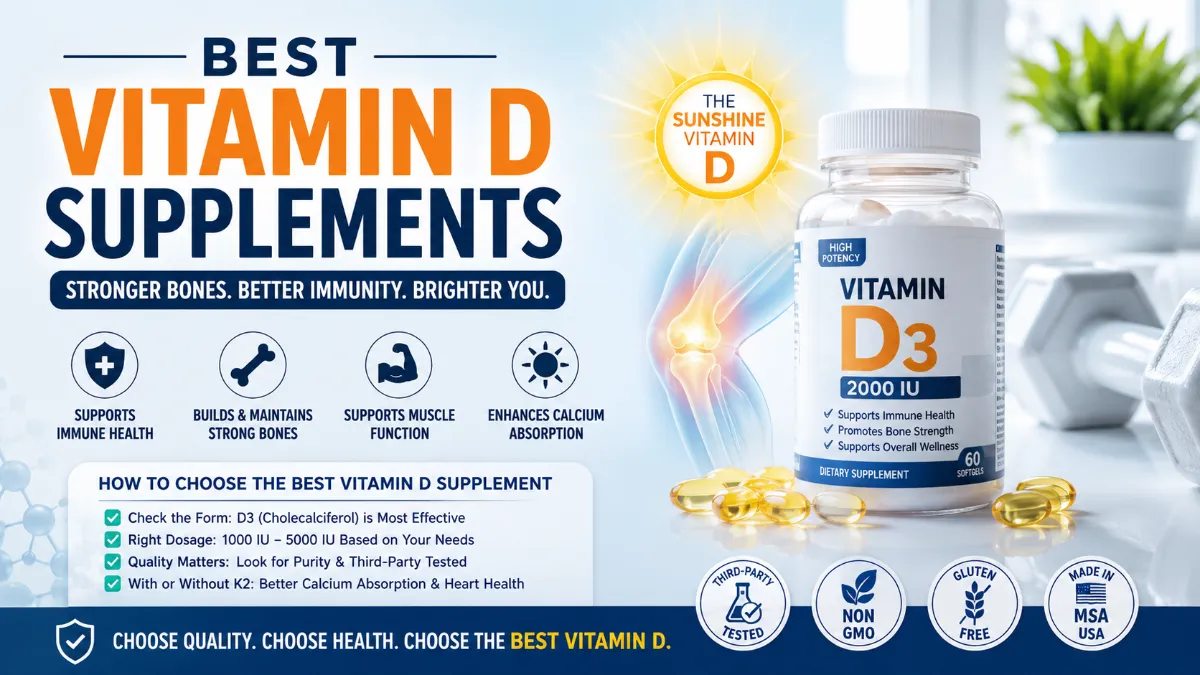
Most people taking vitamin D have no idea whether they are underdosing, overdosing, or buying a supplement that barely contains what the label claims. With hundreds of registered vitamin D formulations flooding the Indian and global market, the real problem is not finding the best vitamin D supplements – it is knowing which brand, which form, and which dose actually works without wasting money or creating long-term health risks. This guide evaluates real brands, real dosages, and real tradeoffs so you can stop guessing and start choosing with confidence.
What Is Vitamin D and Why Does It Matter
Vitamin D is not simply a vitamin – it functions more like a hormone, regulating calcium absorption, immune response, bone density, and muscle strength throughout the body. The best vitamin D supplements work because most adults, despite living in sunny countries, are chronically deficient due to indoor lifestyles, sunscreen use, pollution, and poor dietary intake.
Why Deficiency Is More Common Than You Think
Vitamin D deficiency affects an estimated one billion people globally, including a significant percentage of urban Indians who assume sunlight exposure is sufficient. Office workers, women who cover their skin outdoors, elderly adults, and darker-skinned individuals require longer sun exposure to synthesise equivalent vitamin D, making supplementation practically essential for these groups.
The confusion most buyers face is not about whether to supplement. It is about which form absorbs best, what dose is actually safe, and which brands deliver what the label promises. This guide resolves all three.
How We Evaluated These Products
Before comparing brands, here is the exact methodology used in this guide. This is what separates genuine product evaluation from generic affiliate content.
Evaluation Criteria
| Criterion | What We Assessed |
| Form | D3 vs D2, oil-based delivery vs dry powder vs liquid |
| Dose logic | Is the IU claim appropriate for the stated use case? |
| Third-party certification | USP, NSF, Informed Choice, FSSAI |
| Ingredient transparency | Full excipient disclosure, no proprietary blends |
| K2 form quality | MK-7 preferred for longer half-life, MK-4 acceptable |
| Real-world usability | Capsule size, smell, packaging, travel-friendliness, tolerance |
| Cost per effective serving | Therapeutic value per rupee or dollar |
| India-specific access | FSSAI status, Amazon India availability |
| Long-term safety profile | Toxicity ceiling, drug interactions, and misuse patterns |
This Guide Is NOT For You If
- You have been diagnosed with chronic kidney disease – prescription calcitriol is typically required, not OTC D3.
- You are on a physician-prescribed 60,000 IU weekly sachet protocol – that is a medical correction tool, not a supplement.
- You are seeking pediatric dosing guidance – children require weight-based, doctor-determined dosing.
- You are on warfarin or anticoagulants – K2-containing products require physician clearance first.
Editor’s Pick: Best Overall Vitamin D Supplement
For 90% of healthy adults in India, HealthKart HK Vitals Vitamin D3 + K2 (2,000 IU) is the single best vitamin D supplement available today.
Here is why it earns this position without hesitation: It delivers a clinically appropriate daily maintenance dose – not an aggressive megadose. It pairs D3 with MK-7 K2 for bone and cardiovascular co-benefit. It is FSSAI certified with full ingredient transparency. It costs just Rs 7.48 per serving – well below the category average. The softgels are small, neutral-smelling, and easy to swallow with no artificial dyes or misleading marketing claims.
If you are a healthy Indian adult looking for daily vitamin D support, this is the supplement to buy. The rest of this guide helps everyone else find their specific best fit.
Read More About – How to Treat Fever at Home: Complete Evidence-Based Guide (2026)
Quick Comparison: Best Vitamin D Supplements by Use Case
The best vitamin D supplement for you depends entirely on your situation – your deficiency status, budget, dietary preferences, and health conditions.
| Use Case | Best Pick | Certification | Cost/Serving |
| Daily wellness maintenance | HealthKart HK Vitals D3+K2 (2,000 IU) | FSSAI | Rs 7.48 |
| Clinician-supervised correction | Thorne D3+K2 Liquid | NSF Certified | $0.33 |
| Budget-conscious beginners | Nature Made D3 1,000 IU | USP Verified | $0.05 |
| Confirmed deficiency correction | Transparent Labs D3+K2 (5,000 IU) | Informed Choice | $0.50 |
| Vegans and plant-based users | Garden of Life D3 (Lichen-derived) | Non-GMO, 3rd-party | $0.20 |
| Physician-directed high-dose use | NOW Foods D3 5,000 IU | GMP Certified | Rs 3.71 |
| Fat malabsorption or post-surgery | Sucrosomial Orodispersible D3 | Clinical-grade | Premium |
Top 7 Best Vitamin D Supplements: Honest Brand Reviews
Choosing among the best vitamin D supplements requires looking beyond marketing claims at what is actually inside each product, how it is absorbed, and whether the dose logic makes clinical sense.
1. HealthKart HK Vitals D3 + K2 (2,000 IU) – Best Overall for India
What it is: India’s strongest value-to-quality vitamin D supplement, formulated as a D3 + K2 softgel at a daily maintenance dose appropriate for healthy adults without requiring medical supervision.
Formulation: 2,000 IU cholecalciferol + K2 as MK-7 per softgel. Full ingredient transparency with no proprietary blend hiding the K2 dose.
Real-world observations: The softgels are noticeably smaller than most pharmacy-grade vitamin D capsules, which makes daily compliance easier. There is virtually no smell – a meaningful quality indicator, since cheap imported softgels often carry a fishy or rancid odour signalling oil degradation. Packaging handles Indian humidity conditions adequately. Users report consistent ease of swallowing and no digestive discomfort even on an empty stomach, though taking it with a meal is still recommended for best absorption.
Pros:
- FSSAI certified with verifiable manufacturing standards
- 2,000 IU is the clinically appropriate daily dose for most Indian adults – not a megadose requiring supervision
- MK-7 K2 form provides longer biological activity than the cheaper MK-4 alternative
- Rs 7.48/serving – 66% below the Indian supplement category average
- Strong consumer rating on verified purchase platforms
Cons:
- Not sufficient for correcting severe deficiency – a corrective protocol requires higher doses under supervision
- Not internationally certified (NSF or USP), relies on FSSAI and brand reputation
Best for: Healthy Indian adults wanting daily vitamin D maintenance, office workers with limited sun exposure, budget-conscious users who will not compromise on dose quality.
Avoid if: You have a confirmed blood-test result showing severe vitamin D deficiency.
Price: Approximately Rs 349–529 for 60 capsules
2. Thorne Vitamin D/K2 Liquid – Best Clinician-Grade Option
What it is: The professional standard in vitamin D supplementation. Thorne’s liquid delivers 500 IU D3 per drop with 100 mcg K2 (MK-4 form) in an MCT oil base, allowing precise dose customisation that fixed-dose capsules cannot offer.
Formulation: Cholecalciferol + K2 (MK-4), suspended in medium-chain triglyceride oil with mixed tocopherols as a natural preservative. The MCT oil base ensures fat-soluble absorption regardless of what you eat alongside it.
Real-world observations: The self-dispensing inverted dropper releases one controlled drop per inversion – more accurate than standard pharmacy droppers that tend to release inconsistent amounts. The taste is very mild with a faint neutral coconut note from the MCT base, making it easily tolerable mixed into food or taken directly. The liquid can occasionally seep around the cap during travel if the bottle is placed sideways in a bag – worth keeping upright in a side pocket. One 30 ml bottle provides approximately 600 servings at the minimum dose, making long-term economics reasonable despite the higher upfront cost.
Pros:
- NSF Certified for Sport – the most rigorous independent certification standard in the supplement industry
- Liquid MCT oil base maximises fat-soluble vitamin D absorption independent of meal composition
- Flexible dosing: 500 IU per drop allows physicians to prescribe precise IU targets without switching products
- Neutral taste, no fishy smell – a real differentiator among liquid D3 products
- Compact bottle lasts months at maintenance dosing levels
Cons:
- Premium pricing ($25–$40 per bottle), the costliest option in this guide
- Minor leakage risk during travel if stored horizontally
- MK-4 K2 form – requires more frequent dosing to maintain activity compared to MK-7
Best for: Adults under medical supervision for deficiency correction, practitioners wanting precise dosing control, and users who cannot swallow capsules.
Avoid if: Budget is a primary constraint.
Price: Approximately Rs 2,000–3,500 / $25–$40 per bottle
3. Nature Made Vitamin D3 1,000–2,000 IU – Best Budget Option
What it is: The most accessible certified D3 supplement globally. The USP Verification mark on Nature Made products means an independent laboratory has confirmed that what is on the label is actually in the pill – a critically important distinction in a category where label inaccuracy is documented.
Formulation: Plain cholecalciferol in soybean or safflower oil softgel (formulation varies by batch). No K2, no additives – straightforward D3 in a fat carrier.
Real-world observations: The softgels are small, neutral in taste, and produce no smell whatsoever. The bottle seal is solid with adequate moisture protection. The 240-count bottle format means infrequent reordering, which supports consistency. At approximately $0.05–$0.11 per serving, this is the most cost-efficient way to access certified, verified D3 available anywhere.
Pros:
- USP Verified – independently confirmed label accuracy, which matters enormously in this category
- Lowest cost per serving among all certified supplements reviewed
- Clean formulation: no unnecessary additives, no proprietary blends
- Available globally via iHerb and international pharmacies
Cons:
- Contains soy or safflower oil – relevant for specific allergen concerns
- No K2 – a tradeoff at this price point
- Not available in Indian pharmacies directly; requires online ordering
Best for: Budget-first buyers, first-time vitamin D supplementers, anyone wanting verified D3 at the lowest possible cost per serving.
Price: Approximately Rs 600–900 / $8–$14
4. Transparent Labs Vitamin D3 + K2 (5,000 IU) – Best for Deficiency Correction
What it is: A high-potency, Informed Choice certified D3 + K2 vegan softgel designed specifically for correcting confirmed moderate-to-severe vitamin D deficiency under medical supervision.
Formulation: 5,000 IU cholecalciferol + 200 mcg K2 (MK-7 form) per vegan softgel. The MK-7 K2 dose here is therapeutically meaningful – 200 mcg, not the token 10–20 mcg seen in some cheaper combination products.
Real-world observations: Capsule size is slightly larger than standard softgels – noticeable but manageable for most adults. No taste or smell from the capsule itself. The vegan shell means no gelatin, which matters for plant-based users who still need a high-dose correction option. At $0.50 per serving, the economics make most sense over a defined 90-day deficiency correction cycle, not as an indefinite daily supplement.
Pros:
- Informed Choice certified – one of the strictest anti-contamination and label accuracy standards available
- 5,000 IU corrects the deficiency faster than 2,000 IU when used under appropriate medical guidance
- Full 200 mcg MK-7 K2 dose – clinically relevant, not cosmetic
- Vegan formulation with no animal gelatin
Cons:
- 5,000 IU is not a daily wellness dose – it is a short-term corrective intervention
- Premium pricing relative to the duration of recommended use
- K2 at this level requires physician clearance for anticoagulant users
Best for: Adults with blood-test-confirmed vitamin D deficiency on a supervised 90-day repletion protocol.
Critical buying warning: Do not purchase this supplement without a baseline 25(OH)D blood test. Taking 5,000 IU daily indefinitely “just in case” is the most common vitamin D supplementation mistake documented in Indian clinical literature.
Price: Approximately $0.50/serving, $15–$22 per bottle.
5. Garden of Life Vitamin D3 (Lichen-Derived, 2,000 IU) – Best for Vegans
What it is: The market’s most established vegan D3 supplement using lichen-sourced cholecalciferol – chemically identical to animal-derived D3 and measurably superior to D2 in raising serum vitamin D levels.
Formulation: 2,000 IU lichen-derived D3 per capsule in an organic olive oil base. Non-GMO Project Verified and Certified Vegan labelling visible on packaging.
Real-world observations: Capsules are small and completely odourless. The organic olive oil base supports fat-soluble absorption without synthetic additives. Packaging is sturdy enough for Indian climate conditions, including monsoon humidity. The Certified Vegan and Non-GMO seals are prominently displayed – a meaningful trust signal for the target audience rather than a marketing afterthought.
Pros:
- Lichen-derived D3 is chemically identical to animal D3 – same bioavailability, no animal sourcing
- Non-GMO Verified, Certified Vegan, third-party tested
- No animal gelatin in the capsule shell
- Organic olive oil base for enhanced absorption support
Cons:
- Higher cost than conventional D3 softgels
- Less widely available in Indian offline retail, primarily through online channels
Best for: Vegans, vegetarians, and anyone avoiding animal-derived products who want full vitamin D efficacy without compromise.
Myth corrected here: D2 is not the only vegan option. Lichen-derived D3 has been commercially available for years and consistently outperforms D2 in raising and maintaining serum 25(OH)D levels. Choosing D2 in 2026 when vegan D3 is accessible is selecting a less effective product for no evidence-based reason.
Price: Approximately Rs 800–1,400 / $14–$22
6. NOW Foods Vitamin D3 5,000 IU – Best for Physician-Directed Use
What it is: A GMP-certified, affordable high-potency D3 softgel. Widely available on Amazon India and one of the highest-selling vitamin D products in the Indian supplement market.
Formulation: 5,000 IU cholecalciferol in safflower oil. No K2, no additional ingredients – pure D3 in a clean formulation.
Real-world observations: The softgels are surprisingly small given the high potency – easy to swallow with water. The safflower oil base is light and odour-neutral, unlike some lower-quality oils that produce noticeable fishy or rancid smells. The HDPE bottle maintains quality well under varying temperature conditions. At Rs 3.71 per serving, it is the most affordable high-dose D3 available in India, which is also precisely what drives its misuse.
Pros:
- GMP-certified manufacturing
- Extremely low cost per serving at Rs 3.71
- Safflower oil base – light, allergen-conscious, and stable
- Small capsule size supports daily compliance
Cons:
- 5,000 IU daily without supervision carries a cumulative toxicity risk over extended periods
- No, K2, despite being a dose range where K2 co-supplementation is genuinely beneficial
- High misuse rate in India due to low price and dominant Amazon search visibility
Best for: Adults on a physician-prescribed high-dose D3 protocol with regular blood monitoring.
Avoid if: You are planning to take this daily indefinitely without a blood test or medical guidance.
Price: Approximately Rs 600–900 / $8–$15
7. Sucrosomial Orodispersible D3 – Best for Fat Malabsorption
What it is: A next-generation vitamin D delivery system where D3 is encapsulated in a sucrosomial phospholipid matrix. It dissolves on the tongue and absorbs through the gastrointestinal mucosa without requiring dietary fat co-ingestion – a clinically significant advantage for specific patient populations.
Evidence: Clinical research (published in PMC, 2024) found sucrosomial orodispersible D3 produced significantly higher and more sustained serum 25(OH)D levels compared to standard softgels and chewable tablets in deficient adults. This format was also shown to perform superiorly when standard fat-based delivery is compromised by GI conditions.
Pros:
- Fat-independent absorption – effective even without a fat-containing meal
- Clinically demonstrated superior bioavailability versus softgels in malabsorption studies
- Dissolves on the tongue – no swallowing required
- Particularly valuable post-bariatric surgery, where fat absorption is structurally impaired
Cons:
- Significantly costlier than all other options in this guide
- Overkill and unnecessary for healthy adults with normal digestion
- Limited availability in Indian retail, primarily through specialist pharmacies
Best for: Post-bariatric surgery patients, Crohn’s disease, celiac disease, and clinically confirmed fat malabsorption conditions.
Price: Premium, consult a specialist pharmacy for current pricing
Gummies vs Softgels vs Liquid vs Tablets: The Honest Absorption Comparison
When choosing among the best vitamin D supplements, the delivery format directly determines how much D3 your body actually absorbs.
Absorption Format Comparison
| Format | Absorption Quality | Fat Required | Best For | Key Drawback |
| Oil-based Softgel | High | Enhances | Most healthy adults | None significant |
| Liquid Drops (MCT/olive oil base) | High – equivalent to softgel | Enhances | Elderly, dose-titration | Requires dosing care |
| Sucrosomial Orodispersible | Highest in clinical trials | Not required | Malabsorption conditions | Cost and availability |
| Gummy | Moderate | Needed to close gap | Adherence-focused users | Added sugars, inconsistent dosing |
| Dry Tablet or Dry Capsule | Lowest – no lipid vehicle | Essential | Where softgels unavailable | Significantly inferior without fat |
The gummy question answered honestly: Gummies are not useless. One bioequivalence study found that gummies showed greater short-term bioavailability than plain tablets at 24 hours. However, oil-based softgels demonstrated a 32% greater increase in serum 25(OH)D over 12 weeks compared to gummies in a direct comparison. The real problem with gummies is not just absorption – it is added sugars (2–4g per piece), inconsistent dosing between pieces, and the marketing reality that many gummy vitamin D products use this appealing format to charge a premium for a clinically inferior delivery system.
What Most Buyers Get Wrong When Choosing Vitamin D Supplements
Understanding common mistakes is as important as knowing the top-rated products. These five errors cost buyers money, health outcomes, or both.
Higher IU Is Not Always Better
More vitamin D does not produce proportionally more benefit. Once serum 25(OH)D reaches adequate levels (50–80 nmol/L), additional supplementation provides no further measurable health advantage – but does steadily increase toxicity risk. This is one of the most commercially exploited misconceptions in the entire supplement industry.
Cheap Brands Often Fail on Label Accuracy
Published research in the NIH literature confirmed significant cholecalciferol content disparity across commercial Indian vitamin D brands – meaning the amount in the pill often does not match the label. A four-and-a-half-star rating and 10,000 Amazon reviews mean a product is popular and probably tastes fine. It does not confirm that the labelled IU dose is actually present in each softgel. Third-party certification is the only reliable protection against this.
K2 Is Not Universally Necessary
K2 becomes genuinely important at doses of 3,000 IU or higher, or for users with specific bone or cardiovascular concerns. At a 1,000–2,000 IU daily maintenance dose, K2 is a useful bonus – not a medical requirement for healthy adults with no underlying conditions. Many buyers pay a significant premium for K2 in products they would use perfectly well without it.
D2 Is Not the Vegan Default Anymore
Many vegans still default to D2 (ergocalciferol), assuming it is their only plant-based option. Lichen-derived D3 is chemically identical to animal D3, is now commercially mainstream, and consistently produces better serum vitamin D outcomes. Choosing D2 when vegan D3 is available is choosing a less effective option without a valid reason.
Amazon Reviews Do Not Verify Product Quality
In India’s supplement market, grey-market imports, rebadged formulations, and products with undisclosed manufacturing origins are all common. Consumer reviews measure satisfaction – not label accuracy, contamination risk, or actual cholecalciferol content.
Red Flags: Vitamin D Supplements to Avoid
Some vitamin D products should be avoided entirely, or at a minimum approached with significant caution.
Avoid these product categories:
- 60,000 IU weekly sachets sold as wellness products. These are physician-prescribed clinical correction protocols being misused as over-the-counter supplements. Routine self-directed use is inappropriate and potentially harmful.
- Unknown imported brands with no FSSAI registration. India’s supplement market includes relabeled imports with no verifiable manufacturing trail, no regulatory oversight, and no accountability for label accuracy.
- Gummy products with no certified dosing accuracy. Without third-party verification, the labelled IU amount in a gummy cannot be trusted.
- Products with a proprietary blend of K2. If the K2 dose is not disclosed per serving, it is almost certainly below therapeutic relevance – included for marketing value only.
- Any supplement claiming to boost immunity, fight fatigue, or improve energy via vitamin D. Vitamin D does not boost energy in non-deficient individuals. This language is regulatory borderline marketing, not clinical evidence.
The Indian Market Reality: What Competitors Don’t Tell You
Understanding the best vitamin D supplements for Indian consumers requires understanding the specific market conditions that make India different from Western supplement markets.
The Urban Sunlight Myth
Most urban Indian professionals assume they receive adequate vitamin D from ambient sunlight. This assumption is factually incorrect for millions of city-dwellers who work indoors, commute in cars or covered transport, wear sunscreen, or live in cities where air pollution significantly filters UV-B radiation. Published research confirms that urban north Indian adults are among the most vitamin D-deficient populations despite high ambient sunlight levels in the region.
The 60,000 IU Sachet Problem
India’s most widely prescribed vitamin D treatment – the weekly 60,000 IU sachet – is being self-administered by individuals who find leftover strips at home, buy them over the counter at a pharmacy without a prescription, or assume the higher the dose, the faster the recovery. This is not a supplement strategy. It is a clinical correction tool that requires physician monitoring, baseline testing, and follow-up blood work to use safely. Self-directed weekly sachet use is a genuine public health concern in the Indian context.
Label Accuracy Is Not Guaranteed
The NIH-cited research confirming cholecalciferol content disparity across Indian commercial brands is not theoretical – it reflects real-world testing of products that consumers buy daily. FSSAI certification and brands with verifiable GMP manufacturing addresses substantially reduce but do not eliminate this risk. HealthKart HK Vitals, the editor’s pick in this guide, meets this standard.
How to Use Vitamin D Supplements Correctly
Knowing which supplement to buy is only half the decision. Taking it correctly determines whether it actually works.
Timing and Food Pairing
Take vitamin D with the fattiest meal of your day. Vitamin D is fat-soluble – fat co-ingestion in the same meal significantly enhances absorption through the small intestine, regardless of which certified supplement you choose. A meal containing even 11 grams of fat measurably improves uptake. This is not optional advice; it directly affects blood level outcomes.
Daily vs Weekly Dosing
Daily dosing maintains more stable serum levels than weekly high-dose protocols for healthy adults using maintenance doses. Weekly sachets are clinical tools designed for rapid repletion of severe deficiency – not a convenient substitute for missing daily doses.
Testing Before and After
Get a baseline serum 25(OH)D test before choosing your dose. This single blood test – widely available at diagnostic labs across India for Rs 300–600 – tells you whether you need a maintenance dose (1,000–2,000 IU) or a correction protocol (3,000–5,000 IU under supervision). It removes months of dose guesswork. If correcting a deficiency, a follow-up test at six months confirms whether levels have normalised.
Morning or Afternoon Preferred
Morning or early afternoon dosing is generally preferred by practitioners. Some users report difficulty sleeping when taking D3 late in the evening, though trial evidence on this specific point is not yet definitive.
Side Effects and Safety: What You Actually Need to Know
The best vitamin D supplements are safe at appropriate doses. The toxicity risk is real but largely preventable with one discipline: do not use therapeutic doses without a blood test to justify them.
Dose-Risk Reference
| Daily Dose Range | Risk Level | Appropriate For |
| 1,000–2,000 IU | Very low | Most healthy adults require daily maintenance |
| 2,000–4,000 IU | Low to moderate | Upper NIH tolerable limit for sustained use |
| 5,000 IU | Moderate | Short-term deficiency correction with medical guidance |
| 10,000+ IU | High | Not appropriate for self-directed supplementation |
Hypercalcemia from vitamin D toxicity – elevated calcium in the blood – produces symptoms including fatigue, nausea, excessive thirst, frequent urination, confusion, and kidney pain. It does not occur at 1,000–2,000 IU daily doses. It becomes a realistic risk with sustained intake above 10,000 IU per day or sustained misuse of weekly sachet protocols.
Drug Interactions to Know
- Thiazide diuretics – increase hypercalcemia risk at higher D3 doses
- Warfarin – K2-containing supplements alter anticoagulation; always disclose to your physician
- Orlistat and cholestyramine – both reduce fat absorption and therefore D3 uptake
- Corticosteroids – deplete vitamin D metabolism, and supplementation needs may increase
Food-Based Alternatives to Supplementation
The best vitamin D supplements are not always a pill. Food sources and sunlight contribute meaningfully to vitamin D status, particularly for maintaining adequate levels once deficiency is corrected.
| Source | Approximate D Content | Notes |
| Salmon (85g cooked) | 570–700 IU | The richest practical dietary source |
| Mackerel or sardines | 300–400 IU per serving | Also rich in omega-3 fatty acids |
| UV-exposed mushrooms | 400 IU per 100g | Best plant-based food source |
| Egg yolk (1 large) | 40 IU | Modest but consistent daily contributor |
| Fortified milk (250ml) | 100 IU | Available in India, supplementary role only |
| Midday sunlight (20 minutes) | Equivalent to ~400–1,000 IU | Less effective for darker skin tones, polluted cities |
Food and sunlight work best as maintenance strategies after the deficiency is corrected. Confirmed deficiency almost always requires supplementation to restore adequate serum levels in a clinically meaningful timeframe.
Frequently Asked Questions
What is the best vitamin D supplement overall in 2026?
For most healthy Indian adults, HealthKart HK Vitals D3 + K2 (2,000 IU) is the best overall pick – FSSAI certified, appropriately dosed, and costs just Rs 7.48 per serving. For clinician-supervised deficiency correction, Thorne D3+K2 Liquid leads due to NSF certification and flexible dosing.
Is vitamin D3 better than D2?
Yes. Vitamin D3 raises serum 25(OH)D levels significantly more effectively than D2 and stays active longer in the body. Vegans should choose lichen-derived D3 – not D2, which is the outdated default.
How much vitamin D should I take daily?
1,000–2,000 IU daily is appropriate for most healthy adults as a maintenance dose. Doses up to 5,000 IU are reserved for correcting confirmed deficiency under medical supervision. The NIH upper tolerable limit for sustained daily use is 4,000 IU.
When is the best time to take vitamin D?
Take it with your fattest meal of the day. Fat co-ingestion significantly improves D3 absorption. Morning or early afternoon is generally preferred over evening dosing.
Do I need vitamin K2 with vitamin D?
K2 becomes genuinely important at doses of 3,000 IU or higher, or if you have bone or cardiovascular concerns. At 1,000–2,000 IU daily, it is a useful bonus, not a necessity for most healthy adults. If you take warfarin, consult your doctor first.
Are gummy vitamin D supplements effective?
They work, but oil-based softgels are 32% more effective at raising serum vitamin D levels over 12 weeks compared to gummies. Gummies also contain added sugars and can have inconsistent dosing between pieces.
What should I look for when buying vitamin D in India?
Prioritize FSSAI certification, D3 form (not D2), oil-based delivery, and transparent labeling. Avoid brands with no verifiable manufacturing address, hidden proprietary blends, or extreme daily doses marketed as wellness products.
Can you overdose on vitamin D?
Yes, though it is rare at standard doses. Toxicity risk increases significantly above 10,000 IU per day or with chronic misuse of 60,000 IU weekly sachets without monitoring. Symptoms include nausea, confusion, excessive thirst, and kidney pain.
How long does it take for vitamin D supplements to work?
A measurable rise in 25(OH)D typically occurs within 4–8 weeks of consistent daily supplementation. Full correction of severe deficiency may take 3–6 months. Do not evaluate effectiveness before completing 8 weeks.
Which vitamin D supplement is best for vegans?
Garden of Life D3 (lichen-derived) is the best vegan option – chemically identical to animal D3, certified vegan, and non-GMO verified. It consistently outperforms D2 in raising serum vitamin D levels.
Disclaimer: This article is for informational and educational purposes only. It does not constitute medical advice, diagnosis, or treatment. The best vitamin D supplements for your individual situation depend on your health status, current medications, and confirmed deficiency levels. Always consult a qualified healthcare professional before beginning, modifying, or stopping any supplement regimen - particularly if you are pregnant, have a chronic illness, or take prescription medications.