
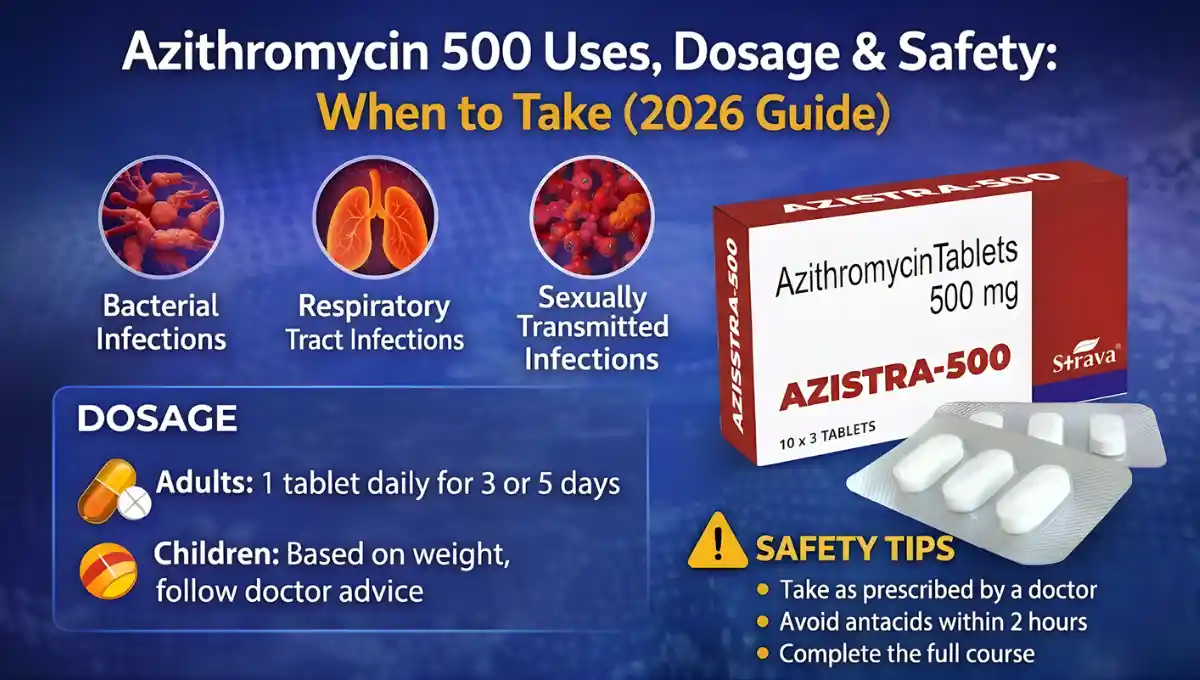
Azithromycin 500 mg should only be taken when a doctor confirms a bacterial infection such as pneumonia, sinusitis, or chlamydia. It must not be used for viral illnesses like cold or flu. The standard adult dose is 500 mg once daily for 3–5 days. For chlamydia, a single 1 gram dose (two 500 mg tablets) is prescribed. Misuse directly causes antibiotic resistance – a documented, measurable, and rapidly growing crisis in India.
Full Summary Table
| Category | Key Information |
|---|---|
| Drug class | Macrolide antibiotic |
| Standard dose | 500 mg once daily |
| Course duration | 3–5 days depending on infection type |
| Use for | Bacterial infections only – confirmed by a doctor |
| Do NOT use for | Cold, flu, COVID-19, or any viral illness |
| Biggest risk | Antibiotic resistance – now at ~22% in Indian clinical samples |
| Who must avoid | Macrolide allergy, severe liver disease, cardiac QT disorder |
| Emergency signs | Palpitations, facial swelling, bloody diarrhoea, skin blistering |
| Pregnancy | Use only under direct medical supervision |
| Key drug interaction | Never combine with amiodarone or sotalol – serious cardiac risk |
5-Second Decision Box
Should you take Azithromycin 500 mg?
| Your Situation | Answer |
|---|---|
| Doctor confirmed a bacterial infection | YES take exactly as prescribed |
| Cold, runny nose, or flu symptoms | NO zero effect on viruses |
| COVID-19 or any viral illness | NO multiple clinical trials proved it ineffective |
| Unsure whether bacterial or viral | STOP see a doctor before taking anything |
| Using leftover tablets from a previous illness | NO requires a fresh diagnosis and prescription |
Azithromycin 500 mg should only be taken when a doctor confirms a bacterial infection such as pneumonia, sinusitis, or chlamydia. It must not be used for viral illnesses like cold or flu. The standard adult dose is 500 mg once daily for 3–5 days. For chlamydia, a single 1 gram dose (two 500 mg tablets) is prescribed. Misuse directly causes antibiotic resistance – a documented, measurable, and rapidly growing crisis in India.
The Dangerous Truth About India’s Most Misused Antibiotic
Azithromycin is the single most consumed antibiotic molecule in India – approximately 640 million defined daily doses were dispensed in 2019 alone, accounting for 12.6% of total national antibiotic consumption.
The scale of misuse is alarming. During just four months of the COVID-19 pandemic peak in India (June–September 2020), an estimated 38 million excess doses of azithromycin were consumed – despite clinical trials confirming it had zero benefit against the virus.
Approximately 50% of all antibiotic prescriptions in Indian primary care settings are inappropriate, with broad-spectrum agents like azithromycin being the most over-prescribed.
The consequence is now measurable: Azithromycin resistance in clinical bacterial samples in India stands at approximately 22% – and continues to rise post-pandemic. Azithromycin-resistant typhoid strains have been independently identified across India, Bangladesh, Pakistan, and Nepal.
Every unnecessary dose accelerates this crisis. This guide exists to help you avoid contributing to it.
Read More About – Paracetamol Uses: Complete Medical Guide to Benefits, Dosage & Safety
What Is Azithromycin 500 mg?
Azithromycin is a broad-spectrum macrolide antibiotic, FDA-approved since 1991, used to treat mild to moderate bacterial infections across multiple body systems. It works by blocking bacterial protein synthesis – stopping bacteria from replicating and spreading. The 500 mg tablet is the standard adult strength. Brand names include Zithromax, Azee, Azithrocin, Sumamed, and Z-Pack.
Why short 3-day courses work: Azithromycin has a terminal half-life of approximately 68 hours, meaning it remains active in body tissues for days after the final dose. This tissue-concentrating property makes it effective at shorter courses than most other antibiotics.
All Approved Azithromycin 500 Uses
Respiratory Infections
Azithromycin 500 mg is the primary macrolide antibiotic for community-acquired pneumonia caused by Streptococcus pneumoniae, Mycoplasma pneumoniae, Haemophilus influenzae, or Chlamydophila pneumoniae in adults suitable for oral treatment. It is also used for acute COPD exacerbations and, in patients with chronic lung conditions such as bronchiectasis, as long-term preventive therapy three times per week.
Atypical pneumonia is a key and unique indication. Standard antibiotics like amoxicillin cannot target atypical organisms such as Mycoplasma – Azithromycin specifically can.
ENT Infections
Azithromycin 500 mg treats acute bacterial sinusitis (3-day course), pharyngitis and tonsillitis caused by Streptococcus pyogenes, and middle ear infections. It is a clinically reliable alternative when the patient cannot tolerate penicillin-based antibiotics.
Skin and Soft Tissue Infections
Azithromycin 500 mg is effective for uncomplicated cellulitis and impetigo caused by Staphylococcus aureus or Streptococcus pyogenes. Note: abscesses require surgical drainage in addition to antibiotics – Azithromycin alone is insufficient.
Sexually Transmitted Infections
A single 1g dose – two 500 mg tablets taken simultaneously – is the standard treatment for chlamydia. Azithromycin is also used in combination regimens for gonorrhoea and for chancroid caused by Haemophilus ducreyi.
Gastrointestinal Infections
Azithromycin is prescribed for traveller’s diarrhoea, Campylobacter enteritis, and as an alternative for typhoid fever. However, azithromycin-resistant typhoid strains have been identified in India – susceptibility testing before prescribing is increasingly important.
Other Conditions
- Lyme disease – alternative for patients who cannot tolerate doxycycline
- Disseminated MAC infection in HIV/AIDS patients – both prevention and treatment
- Cat-scratch disease (Bartonella henselae) – severe cases
When Azithromycin Does NOT Work
This is the section most people need to read most carefully.
Azithromycin is completely ineffective against:
- All viral infections – cold, influenza, COVID-19, RSV, and norovirus
- Antibiotic-resistant bacterial strains – rising rapidly across India
- Fungal infections – thrush, ringworm, candida
- MRSA – (methicillin-resistant Staphylococcus aureus)
On COVID-19 specifically: Multiple large-scale randomised controlled trials confirmed that Azithromycin provides no clinical benefit in COVID-19. The WHO does not recommend it. Yet during the 2020 pandemic peak, nearly every COVID-19 patient in India received an antibiotic – directly contributing to the current 22% resistance rate.
If your symptoms do not improve within 2–3 days on Azithromycin, contact your doctor immediately. The infection may be viral, resistant, or misdiagnosed. Do not continue the course blindly.
Why Treatment Fails: 3 Clinical Reasons
1. Antibiotic Resistance
Azithromycin resistance in Indian clinical samples is currently approximately 22% and increasing. When resistance is present, the drug cannot bind effectively to the bacterial ribosome – it fails regardless of dose or duration.
2. Wrong Diagnosis – Viral Infection Treated as Bacterial
The majority of upper respiratory infections are viral. Azithromycin prescribed for these conditions does absolutely nothing. Recovery is due to the patient’s own immune system – not the antibiotic.
3. Non-Compliance – Stopping the Course Early
Stopping after 2 days of improvement leaves the strongest, most resistant bacteria alive. They multiply, return, and cause a relapse that is harder – sometimes much harder – to treat.
Doctor’s Point of View: When Doctors Do NOT Prescribe Azithromycin
This is the clinical decision-making perspective rarely presented in patient-facing content.
| Clinical Situation | Why Doctors Avoid It |
| Suspected or confirmed viral infection | No mechanism of action – unnecessary resistance risk |
| Known macrolide resistance in the area | Drug will fail – a different antibiotic class is required |
| QT prolongation or cardiac arrhythmia | Azithromycin worsens the electrical abnormality – serious cardiac risk |
| Patient on amiodarone or other QT-prolonging drugs | Combination significantly increases dangerous arrhythmia risk |
| Severe liver disease | Drug is hepatically metabolised – impaired clearance raises toxicity risk |
| Strep throat without penicillin allergy | Amoxicillin is the first-line drug – Azithromycin is second-line |
| Confirmed macrolide allergy | Absolute contraindication |
Reality vs. Myth
| What People Believe | Medical Reality |
| Antibiotics cure infections faster | Azithromycin stops bacterial growth – the immune system finishes the work. There is no shortcut. |
| I feel better in 2 days, so I can stop | The strongest bacteria are still present. Stopping early drives resistance and relapse. |
| My friend had the same symptoms, and it worked | Same symptoms can have different causes – or be entirely viral. Prescriptions are not transferable. |
| Azithromycin worked for COVID-19 | Multiple large trials disproved this. WHO does not recommend it for COVID-19. |
| More tablets mean faster recovery | Higher doses increase side effects and resistance without improving outcomes. |
| Leftover antibiotics are fine to reuse | A previous prescription is specific to a specific infection. Reusing it is medically unsafe. |
Dosage: Safe General Guidance
The following is educational guidance only. A doctor determines your correct dose based on your infection type, organ function, body weight, and full medical history.
Standard Adult Dosage
| Condition | Dose | Duration |
| Community-acquired pneumonia | 500 mg Day 1, then 250 mg Days 2–5 | 5 days |
| Acute sinusitis | 500 mg once daily | 3 days |
| Acute bronchitis / COPD exacerbation | 500 mg once daily | 3 days |
| Pharyngitis / tonsillitis | 500 mg Day 1, then 250 mg Days 2–5 | 5 days |
| Skin infections (cellulitis, impetigo) | 500 mg Day 1, then 250 mg Days 2–5 | 5 days |
| Chlamydia (STI) | 1g – two 500 mg tablets simultaneously | Single dose |
| Long-term COPD / bronchiectasis prevention | 250–500 mg | 3x/week – Mon, Wed, Fri |
How to Take It Correctly
- Take at the same time each day for consistent blood and tissue levels
- Tablets and liquid can be taken with or without food
- Capsules must be taken on an empty stomach – at least 1 hour before or 2 hours after eating
- Never take aluminium or magnesium antacids within 2 hours – they significantly reduce drug absorption
- Never take a double dose to compensate for a missed one
- Swallow tablets whole with a full glass of water
Also Read – Ibuprofen Uses: The Complete Safety & Dosage Guide
Side Effects: Normal vs. Emergency
Most side effects are mild and resolve on their own. The serious effects below require immediate action – do not dismiss them.
| Side Effect | Severity | Action |
| Mild nausea after first dose | Common, expected | Take with light food next time – continue course |
| Loose stools 1–2 times daily | Common, resolves | Monitor – continue unless severe |
| Mild headache or dizziness | Minority of patients | Rest – avoid driving |
| Metallic or altered taste | Known macrolide effect | Temporary – continue course |
| Severe or bloody diarrhoea | Serious – possible C. difficile | STOP IMMEDIATELY – see doctor today |
| Skin rash, hives, facial or throat swelling | Serious – possible anaphylaxis | EMERGENCY – call ambulance immediately |
| Palpitations, irregular heartbeat, fainting | Serious – possible QT prolongation | STOP – emergency care required immediately |
| Yellowing of skin or eyes | Serious – possible liver toxicity | See doctor today |
| Severe skin blistering | Rare – possible Stevens-Johnson Syndrome | EMERGENCY |
Precautions and Safety
Who Must NOT Take Azithromycin 500 mg
- Confirmed allergy to azithromycin, erythromycin, clarithromycin, or any macrolide
- Known QT prolongation or serious cardiac arrhythmia
- Severe liver disease
- Critically low potassium or magnesium levels
Special Patient Groups
| Patient Group | Key Guidance |
| Pregnant women | Pregnancy Category B – use only when clearly necessary, under direct medical supervision |
| Breastfeeding mothers | Passes into breast milk – use only under medical advice |
| Children | From 6 months of age at 10 mg/kg/day (max 500 mg/day) – liquid suspension standard for young children |
| Elderly patients | Higher QT risk – cardiac monitoring may be recommended |
| Kidney disease (mild–moderate) | Generally no dose adjustment required |
| Liver disease (significant) | Careful evaluation required – drug is cleared by the liver |
Drug Interactions
Always disclose every medication you are taking – including supplements and herbal products. The interactions below range from clinically significant to potentially life-threatening.
| Drug / Class | Risk | Action |
| Amiodarone, sotalol, dronedarone | Dangerous QT prolongation – cardiac risk | Avoid – inform cardiologist |
| Citalopram, escitalopram, haloperidol | Additive QT prolongation | Inform prescribing doctor |
| Warfarin | Increased bleeding risk | Monitor INR throughout course |
| Aluminium / magnesium antacids | Significantly reduces absorption | Separate by at least 2 hours |
| Digoxin | Azithromycin may raise digoxin blood levels | Monitor levels during treatment |
| Cyclosporine | Azithromycin may raise cyclosporine levels | Close monitoring required |
| Other macrolide antibiotics | Additive toxicity risk | Do not combine |
Azithromycin vs. Other Antibiotics
Azithromycin is not always the first-choice antibiotic. Clinical guidelines reserve it for specific indications.
| Feature | Azithromycin | Amoxicillin | Doxycycline |
| Best clinical use | Atypical pneumonia, STIs, ENT | Strep throat, ear infections | Lyme disease, acne, STIs |
| Dosing frequency | Once daily | 2–3 times daily | Once–twice daily |
| Course length | 3–5 days | 7–10 days | 7–14 days |
| Safe with penicillin allergy | Yes | No | Yes |
| QT prolongation risk | Moderate | Minimal | Minimal |
| Effective against atypical bacteria | Yes | No | Yes |
| Resistance concern in India | High – ~22% in clinical samples | Moderate | Moderate |
Biggest Mistakes People Make with Azithromycin
Stopping the course early. Surviving bacteria – the most resistant ones – are still present when symptoms improve. Stopping early allows them to multiply. The next infection becomes measurably harder to treat.
Taking it for viral illness. Azithromycin has zero mechanism of action against viruses. India consumed 38 million excess doses during just four months of the COVID-19 pandemic – directly contributing to the current ~22% resistance rate in clinical samples.
Self-medicating without diagnosis. Over 58% of antibiotics in India are used unnecessarily. Community pharmacies frequently dispense Azithromycin without a prescription. Every unsupervised dose accelerates resistance.
Taking it with antacids. Aluminium and magnesium antacids significantly reduce Azithromycin absorption. This lowers the drug’s effectiveness without reducing its side effect risk – a dangerous trade-off.
Ignoring cardiac symptoms. Palpitations or irregular heartbeat during an Azithromycin course are not routine side effects. They may indicate QT prolongation – stop the course and seek emergency medical attention immediately.
When to See a Doctor
Go to a Doctor or Emergency Care Immediately If:
- Symptoms show no improvement after 2–3 days on Azithromycin
- You develop severe or bloody diarrhoea during or after the course
- You experience chest pain, palpitations, or fainting
- Skin or eyes turn yellow – potential liver toxicity
- Severe skin rash, blistering, or peeling develops
- Throat or facial swelling with difficulty breathing – call emergency services immediately
- Fever worsens or new symptoms appear while on the course
Complete User Action Plan
Before taking Azithromycin 500 mg:
- Confirm a doctor has diagnosed a bacterial infection and issued a prescription
- Disclose all current medications – especially cardiac, psychiatric, and blood-thinning drugs
- Disclose any history of liver disease, heart rhythm disorders, or macrolide allergy
While taking the course:
- Take at the same time each day for consistent blood and tissue levels
- Complete every dose – even after symptoms fully resolve
- Wait at least 2 hours if you also need an antacid
- Monitor for the emergency warning signs listed in the side effects section
What you must never do:
- Never take Azithromycin for a cold, flu, or any viral illness
- Never stop the course early because symptoms have improved
- Never share your prescription with anyone else
- Never reuse leftover antibiotics from a previous illness
Frequently Asked Questions
1. What is Azithromycin 500 mg used for?
Azithromycin 500 mg treats bacterial infections including community-acquired pneumonia, sinusitis, bronchitis, tonsillitis, ear infections, skin infections, chlamydia, and traveller’s diarrhoea. It blocks bacterial protein synthesis. It has no effect on viral infections.
2. How many days should I take Azithromycin 500 mg?
3 days for sinusitis, 5 days for pneumonia and most infections, and a single 1g dose for chlamydia. Always complete the exact course prescribed. Never stop early.
3. Does Azithromycin work for COVID-19, flu, or cold?
No. Multiple large clinical trials confirmed it has no benefit in COVID-19. It has no mechanism of action against any virus. Taking it for a viral illness creates resistance without any therapeutic benefit.
4. What is the biggest mistake people make with Azithromycin?
Stopping the course early after feeling better. The most resistant bacteria survive and multiply, causing a harder-to-treat relapse. The full prescribed course must always be completed.
5. Can I take Azithromycin on an empty stomach?
Tablets and liquid can be taken with or without food. Capsules must be taken on an empty stomach. Avoid aluminium or magnesium antacids within 2 hours – they significantly reduce absorption.
6. What are the serious side effects of Azithromycin?
Serious but rare effects include QT prolongation (irregular heartbeat), anaphylaxis (severe allergic reaction), C. difficile colitis (bloody diarrhoea), liver toxicity (jaundice), and Stevens-Johnson Syndrome. Seek emergency care immediately if any of these occur.
7. When do doctors NOT prescribe Azithromycin?
Doctors avoid it for suspected viral infections, patients with cardiac QT disorders, patients on amiodarone or QT-prolonging drugs, severe liver disease, known macrolide resistance in the target pathogen, and confirmed macrolide allergy.
8. Is Azithromycin safe during pregnancy?
Classified as Pregnancy Category B. Use only when clearly necessary and under direct medical supervision. Never self-medicate during pregnancy.
9. What is the difference between Azithromycin 250 mg and 500 mg?
Both contain the same antibiotic at different strengths. The 500 mg is the standard single daily adult dose. Some protocols use 500 mg on Day 1 followed by 250 mg on Days 2–5 – a loading dose approach that achieves faster initial therapeutic tissue levels.
10. Why is azithromycin resistance a serious problem in India?
India consumed 640 million defined daily doses in 2019 and 38 million excess doses during the COVID-19 pandemic alone. Azithromycin resistance in clinical samples now stands at approximately 22%. This means the drug is already failing for roughly 1 in 5 bacterial infections in some clinical settings – and inappropriate use accelerates this further.
Medical Disclaimer: This article is intended for informational and educational purposes only. It does not constitute medical advice, diagnosis, or prescription. Always consult a registered healthcare professional before starting, stopping, or changing any medication. Medical guidelines may vary by country. This content reflects guidance from WHO-aligned sources including NHS, HSE Ireland, and Healthdirect Australia as of April 2026.