

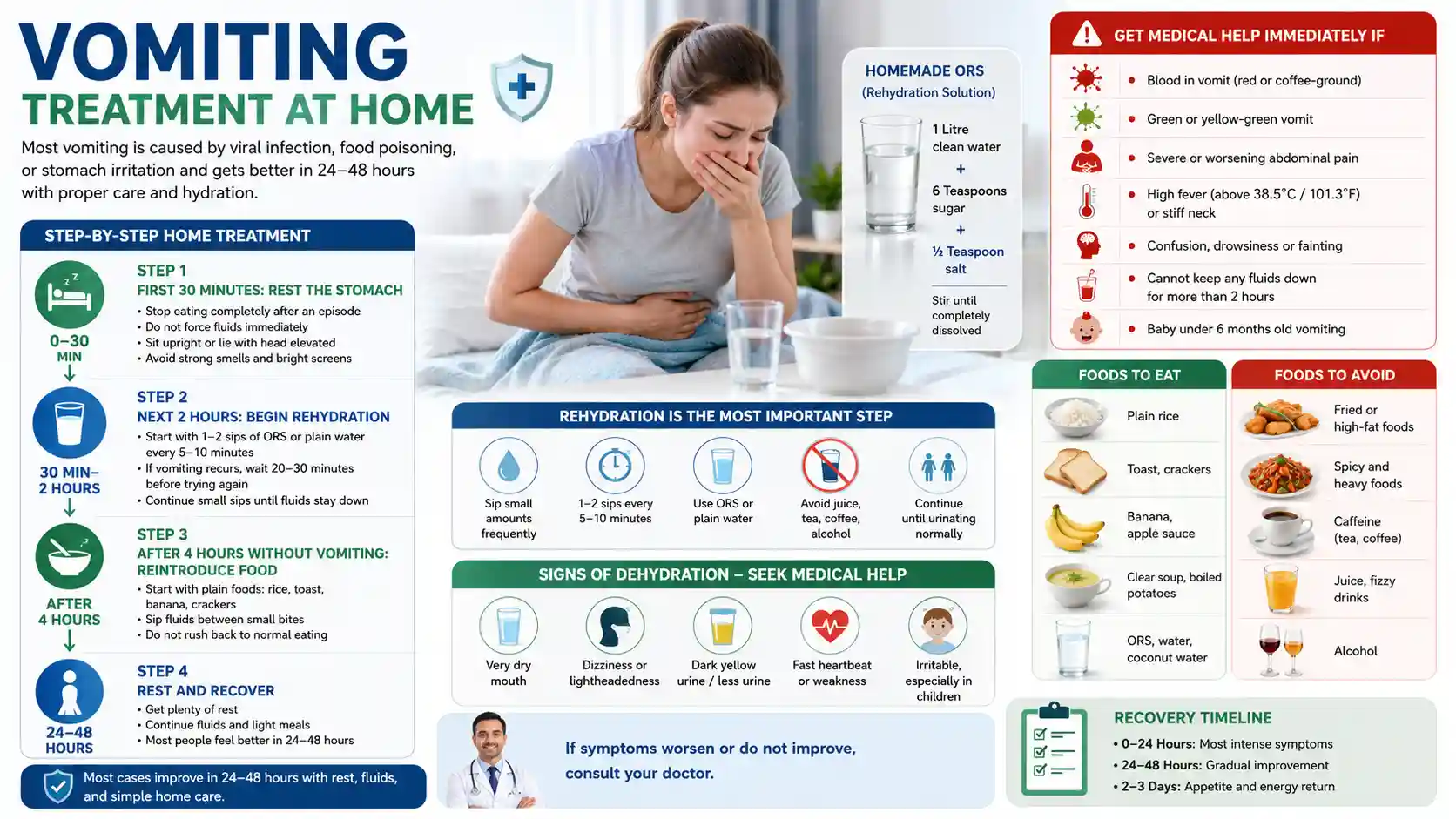
Vomiting treatment at home starts with one rule: stop eating, rest your stomach, and begin slow rehydration with ORS or plain water. Most cases caused by viral infection, food poisoning, or stomach irritation resolve within 24–48 hours without medication. The real danger is not the vomiting itself – it is dehydration and missing warning signs like blood in vomit, green-coloured vomit, or inability to keep any fluids down. Act on those signals immediately.
What You Actually Need to Know
Most people searching for vomiting treatment at home are not looking for a textbook definition. They want three things: Is this serious? What do I do right now? When should I go to a doctor?
This guide answers all three clearly and in order. Vomiting is one of the most common symptoms across all age groups, triggered by viral infections, food poisoning, motion sickness, medications, or pregnancy. According to NHS guidelines, the majority of cases are self-limiting and respond well to simple home care focused on preventing dehydration and allowing the stomach to rest.
The guide covers exact step-by-step home treatment, a recovery timeline, foods to eat and avoid, common mistakes to skip, medicine guidance, and clear escalation signals. So you know exactly when home care is enough and when it is not.
Is This an Emergency? Read This First
Before starting any vomiting home treatment, quickly check for red flags. Some cases require immediate emergency care – not home management.
Go to emergency services or A&E immediately if vomiting is accompanied by:
- Blood in vomit – bright red, dark brown, or coffee-ground appearance.
- Green or yellow-green vomit (may indicate bile).
- Severe or suddenly worsening abdominal pain.
- Chest pain, confusion, or blurred vision.
- High fever with stiff neck – potential meningitis.
- Signs of suspected poisoning or medication overdose.
- A baby under 6 months vomiting – always a doctor visit.
If none of the above apply, home management is appropriate for most adults and older children. Continue below.
When Vomiting Is Usually Not Serious
Understanding what is normal versus dangerous is the most important part of vomiting treatment at home. Most cases are uncomfortable but not harmful.
These patterns are typically safe for home care:
- 1–3 vomiting episodes over a few hours
- Mild nausea, low appetite, and slight fatigue
- Low-grade fever below 38°C / 100.4°F
- Gradual improvement within 24 hours
- Able to keep small sips of fluid down after resting
The body is doing its job. Your goal is to support hydration and rest – not immediately suppress the process. Suppressing vomiting too early with antiemetics can mask symptoms of a more serious underlying condition.
Most Likely Caused by Vomiting Symptoms
One of the most common questions alongside vomiting treatment at home is: “What is actually causing this?” Matching your symptom pattern helps you decide how to respond.
Symptom Pattern Matching
| Symptom Pattern | Most Likely Cause |
| Vomiting + diarrhoea + stomach cramps | Viral gastroenteritis (stomach flu) |
| Vomiting within hours of shared food or takeaway | Food poisoning |
| Morning vomiting in early pregnancy | Morning sickness/hyperemesis |
| Vomiting + severe one-sided headache | Migraine |
| Vomiting in a moving vehicle | Motion sickness |
| Vomiting after starting a new medication | Medication side effect – check the leaflet |
| Vomiting + fever + bloody diarrhoea | Bacterial infection – medical review needed |
| Vomiting + chest pain or sudden severe headache | Emergency – seek care immediately |
Clinical insight: Vomiting that is sudden, short-duration, and mostly accompanied by nausea is far more likely to be viral. Bacterial causes tend to produce fever, bloody diarrhoea, and symptoms that worsen rather than improve over 24–48 hours. Viral gastroenteritis is the most common cause of acute vomiting in adults globally.
What Is Normal vs What Is Not Normal
| Usually Normal | Not Normal |
| Vomiting 1–3 times in a few hours | Vomiting continuing beyond 48 hours in adults |
| Mild stomach discomfort and fatigue | Green, brown, or blood-tinged vomit |
| Low-grade fever alongside nausea | Confusion or inability to stay awake |
| Gradual improvement within 24 hours | No urination for 8+ hours |
| Appetite slowly returns after 24 hours | Severe, worsening abdominal pain |
Myth vs Reality: Many people believe vomiting after food poisoning should be stopped immediately with medication. In reality, early vomiting is often the body clearing a harmful trigger. Suppressing it too soon can delay recovery. Hydration – not suppression – is the first priority.
Vomiting Treatment at Home: Exact Step-by-Step Action Plan
The most effective vomiting home treatment follows a timed sequence – not scattered actions. NHS and WHO guidelines both prioritize stepwise rehydration over medication in the first hours.
Step 1 – First 30 Minutes: Rest the Stomach
- Stop eating completely after an episode
- Do not force fluids immediately – let the acute episode settle
- Sit upright or lie with head elevated – never lie flat after vomiting
- Avoid strong smells or bright screens that worsen nausea
Step 2 – Next 2 Hours: Begin Careful Rehydration
- Start with 1–2 small sips of ORS or plain water every 5–10 minutes
- If vomiting recurs, wait 20–30 minutes before trying fluids again
- WHO Homemade ORS: 1 litre clean water + 6 teaspoons sugar + ½ teaspoon salt – stir until dissolved
- Continue small sips consistently until fluids stay down
Step 3 – After 4 Hours Without Vomiting: Reintroduce Food
- Start with plain rice, dry toast, crackers, or a banana.
- Continue sipping fluids between small bites.
- Do not rush back to normal eating – give the stomach time.
Call a Doctor Today If:
- You cannot keep any fluid down after 2 hours of trying.
- Signs of dehydration appear – see section below.
- A child under 2 has been vomiting for more than 12 hours.
Recovery Timeline: What to Expect
A clear timeline helps answer the most common anxious question: “Is this taking too long?”
| Time | What Usually Happens |
| 0–6 hours | Active nausea, vomiting episodes, and stomach cramping |
| 6–24 hours | Vomiting slows, stomach gradually settles, fatigue persists |
| 24–48 hours | Appetite slowly returns, and bland foods become tolerable |
| Beyond 48 hours | Still vomiting – medical review is now required |
If improvement is not happening by hour 24, reassess. Most viral gastroenteritis cases in otherwise healthy adults follow this pattern closely.
Dehydration: The Real Risk in Vomiting
Dehydration – not the vomiting itself – is what causes serious complications. Recognising it early is the single most important skill in vomiting treatment at home.
Dehydration Warning Signs in Adults
- Dark yellow or very strong-smelling urine
- Dry mouth, lips, and tongue
- Dizziness when standing up
- No urination for 8+ hours
- Rapid pulse or extreme, sudden weakness
Dehydration Warning Signs in Children
- Fewer wet nappies or no urination
- Crying without producing tears
- Sunken eyes or sunken fontanelle in babies
- Lethargy, unusual irritability, or limpness
Clinical insight: Children can appear alert and active even while significantly dehydrated. Reduced urination is consistently a more reliable early warning sign than activity levels or energy. Doctors frequently see parents delay ORS treatment because the child seemed “fine” – only for dehydration to worsen rapidly. Do not use energy levels alone as your guide.
Foods and Drinks: What Helps vs What Harms
Choosing the right foods and fluids is a core part of effective vomiting treatment at home. The wrong choices – especially drinks – are one of the most common reasons home treatment fails.
Eat and Drink These
- Plain rice, dry toast, crackers – easy to digest, low gastric load
- Banana, applesauce, boiled potatoes – gentle on an irritated stomach
- ORS, clear broth, plain water – the gold standard for rehydration
- Ginger tea or plain biscuits – clinically recognised support for nausea
- Plain oats or porridge as appetite returns
Avoid These
- Spicy, fried, or fatty foods increase gastric acid and worsen nausea
- Dairy products – harder to digest, can trigger further stomach irritation
- Fruit juices – high sugar content actively worsens nausea
- Coffee and caffeinated drinks – gastric irritants with mild diuretic effects
- Alcohol – A dangerous combination with dehydration
Can I Drink Milk, Coffee, or Cola?
Milk: Avoid during and for 24 hours after vomiting. Dairy is more difficult to digest on an irritated stomach and commonly worsens nausea.
Coffee: Avoid completely. Caffeine is a gastric irritant and a mild diuretic – the exact opposite of what a dehydrated body needs during recovery.
Cola or fizzy drinks: This is one of the most widespread and damaging myths in home treatment. The sugar content and carbonation of cola actively worsen nausea and delay recovery. Flat cola is not a medical remedy – it is not supported by clinical evidence. Use ORS.
Read More – Fever Symptoms and Treatment (2026 Edition): What Patients Really Get Wrong
Home Remedies for Vomiting: What Actually Works
Effective home remedies for vomiting focus on reducing nausea and supporting hydration – not on suppressing the body’s natural protective response.
Ginger
Ginger has well-documented antiemetic properties and is one of the few home remedies with clinical support. Ginger tea, ginger biscuits, crystallised ginger, or fresh ginger in warm water are all effective options. Safe for adults and older children. It supports ORS – it does not replace it.
Peppermint
Peppermint tea or peppermint oil inhaled gently can reduce the sensation of nausea for some people. The effect is mild but safe. Avoid in babies and very young children.
Cold Compress
Placing a cool, damp cloth on the forehead or back of the neck can ease the feverish, overheated feeling that often accompanies acute vomiting episodes.
Fresh Air and Positioning
Moving to a cool, well-ventilated space and sitting upright reduces the intensity of nausea significantly – particularly for motion sickness and anxiety-related vomiting.
What does not work: Eating dry crackers immediately after vomiting, drinking large amounts of water at once, or consuming sugary drinks. These are among the most common mistakes and worsen outcomes.
Most Common Mistakes in Vomiting Home Treatment
These are what clinicians observe most frequently – and every one is avoidable:
- Drinking large amounts of water too quickly – large gulps reliably trigger another vomiting episode, small sips only, every 5–10 minutes
- Switching to cola or fruit juice instead of ORS – sugar and carbonation worsen nausea directly
- Taking ibuprofen on an empty, irritated stomach – worsens gastric inflammation. Use paracetamol if fever relief is needed
- Forcing food before fluids are tolerated delays recovery and increases the risk
- Stopping ORS once vomiting pauses – dehydration risk continues hours after episodes stop
- Giving children adult antiemetics – not appropriate without paediatric medical guidance
Clinical insight: The most common pattern seen after food poisoning is patients drinking a full glass of water to “flush it out.” This reliably causes another vomiting episode and increases net fluid loss. The counterintuitive truth is that less fluid, given more frequently, is far more effective than large quantities.
Medicines for Vomiting: Safe and Responsible Use
Medication is not the first step in vomiting treatment at home. ORS, rest, and careful rehydration come first. Most mild vomiting resolves without any antiemetics.
Medicine Guide
| Medicine Type | When It Helps | Key Caution |
| ORS sachets | First-line treatment for all vomiting with dehydration risk | Available at pharmacies, follow packet instructions |
| Paracetamol | Fever or pain alongside vomiting | Never exceed stated dose, no aspirin for under-16s |
| Antiemetics (domperidone, ondansetron) | Persistent vomiting – doctor-prescribed only | Require professional advice, not for self-prescription |
| Antihistamines (promethazine) | Motion sickness–related vomiting | Causes drowsiness, not for children under 2 |
One rule covers everything: Use ORS first. Use paracetamol only if fever or pain is significant. Do not self-prescribe antiemetics – they can mask serious symptoms that require investigation.
Special Populations: Higher Risk, Different Rules
Certain groups need a different approach to home treatment for vomiting because their risk of complications is significantly higher.
Babies Under 6 Months
Any vomiting in a baby under 6 months requires a doctor’s visit. Do not attempt home management without professional guidance. Dehydration develops faster in infants than in any other group.
Children Under 2
Vomiting beyond 12–24 hours requires medical review. Use paediatric ORS only – not plain water alone, undiluted formula, or juice. Monitor wet nappies closely.
Pregnant Women
Mild morning sickness is common and manageable with small, frequent meals, ginger, and hydration. Severe persistent vomiting – hyperemesis gravidarum – is a clinical condition requiring specialist treatment and IV rehydration in some cases. No antiemetic without obstetric guidance.
Elderly Adults (65+)
Dehydration progresses faster and shows later in older adults. Any vomiting lasting more than 24 hours warrants medical assessment – do not wait for “dramatic” symptoms before seeking help.
People With Diabetes
Vomiting disrupts glucose regulation directly. Check blood sugar levels promptly and seek medical advice if vomiting does not resolve within a few hours – diabetic ketoacidosis is a risk in type 1 diabetes specifically.
When to See a Doctor vs. Go to Emergency
Call a Doctor or Visit Urgent Care Today If:
- Vomiting continues beyond 24 hours in children or 48 hours in adults
- Signs of dehydration are not improving with ORS
- You suspect a new medication is the cause
- A child under 5 has any signs of dehydration
Go to Emergency – Do Not Wait – If:
- Blood, green vomit, or coffee-ground material appears
- Severe or suddenly worsening abdominal pain is present
- Chest pain, confusion, blurred vision, or stiff neck may occur
- Suspected poisoning or medication overdose
- Cannot keep any fluid down for more than 2 hours, and dehydration signs are present
- Rapid pulse, extreme weakness, or inability to stay awake
Frequently Asked Questions
What is the fastest way to stop vomiting at home?
Stop eating for 30–60 minutes after an episode, then take 1–2 small sips of ORS or plain water every 5–10 minutes. The biggest risk from vomiting is dehydration – not the vomiting itself. Tiny, frequent ORS sips matter far more than antiemetics in the first few hours. Once fluids stay down for several hours, reintroduce bland foods like plain rice, toast, or crackers.
When should you go to the hospital for vomiting?
Go to the emergency immediately if vomiting contains blood or is green-coloured, or if it is accompanied by chest pain, severe abdominal pain, confusion, or stiff neck. Also seek emergency care if you cannot keep any fluid down for more than 2 hours and show signs of dehydration – rapid pulse, no urination, and confusion.
What foods should you eat after vomiting?
Start with plain rice, dry toast, crackers, banana, applesauce, or boiled potatoes. Avoid dairy, spicy, fried, and fatty foods for at least 24 hours. Reintroduce normal eating only after bland foods are tolerated without nausea returning. Never force food before fluids are kept down comfortably.
How do I know if I am dehydrated after vomiting?
The most reliable early signs are dark yellow urine, dry mouth and lips, dizziness on standing, and no urination for 8+ hours. In children, watch for no tears when crying and fewer wet nappies – these are more reliable than activity levels. Start ORS at the first sign and seek medical advice if dehydration symptoms worsen.
Can I sleep after vomiting?
Yes – rest is an important part of recovery. Sleep with your head and upper body elevated to reduce aspiration risk and acid reflux. Do not lie flat immediately after drinking fluids. If vomiting wakes you from sleep, is projectile, or is accompanied by a severe headache, these patterns can indicate a non-gastrointestinal cause that needs assessment.
Is ginger effective for nausea and vomiting?
Yes. Ginger has clinically recognised antiemetic properties, particularly for nausea associated with pregnancy, motion sickness, and viral illness. Ginger tea, ginger biscuits, or crystallised ginger are safe and practical options for adults and older children. They work best alongside ORS – not as a replacement for rehydration.
How long does vomiting from food poisoning last?
Most food poisoning–related vomiting lasts between 1 and 3 days, with the worst symptoms typically peaking in the first 12–24 hours. Improvement should be gradual but noticeable. If vomiting from suspected food poisoning continues beyond 3 days or is accompanied by blood, fever, or severe pain, medical review is essential.
What is the best drink for vomiting and dehydration?
Oral rehydration solution (ORS) is the gold standard – it replaces both fluids and electrolytes lost during vomiting. Plain water is the second option. Avoid cola, fruit juice, fizzy drinks, and caffeine – all of these worsen nausea and do not replace electrolytes effectively. WHO-recommended homemade ORS: 1 litre of clean water + 6 teaspoons of sugar + ½ teaspoon of salt.
Can vomiting be a sign of something serious?
Most acute vomiting is caused by viral gastroenteritis or food poisoning and is not serious. However, vomiting can signal serious conditions including appendicitis, meningitis, bowel obstruction, diabetic ketoacidosis, or a neurological event – especially when accompanied by severe pain, stiff neck, confusion, or chest pain. These combinations are always emergencies.
Should I give my child medicine to stop vomiting?
Do not give children antiemetics without paediatric medical guidance. For most children, ORS and rest are sufficient. Never give aspirin to anyone under 16 due to the risk of Reye’s syndrome. Paracetamol in the correct paediatric dose may help if fever or discomfort is significant. If a child under 2 is vomiting persistently, see a doctor rather than attempting home treatment alone.
Medical Disclaimer: This content is for informational purposes only and is not a substitute for professional medical advice. Always consult a qualified healthcare provider - especially for children, pregnant women, elderly individuals, and people with chronic conditions.